 |
|
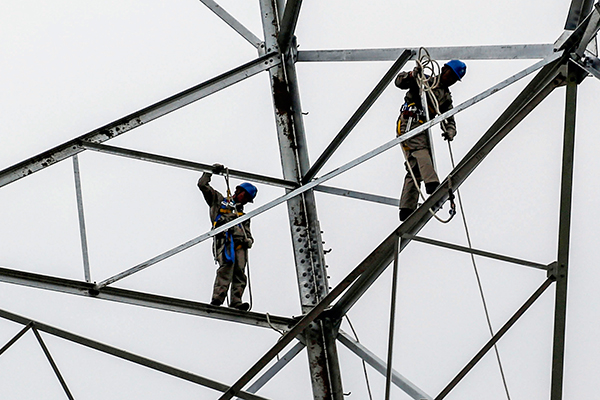
Workers install ultra-high-voltage transmission facilities that connect the Inner Mongolia autonomous region and Jiangsu province. [Photo/China Daily] |
Ultra-high-voltage transmission routes in Inner Mongolia autonomous region are helping transmit clean-energy and coal-fired electricity to the rest of the nation over long distances in order to balance out China's uneven energy supplies, according to experts.
"With the help of UHV, Inner Mongolia is developing into a key clean-energy export center in northern China," said Yin Xiuhe, a researcher at the power department of the region's energy bureau.
There are four UHV routes in the region. The latest to be put into operation is the 1,000-kilovolt Xilin Gol League-Shandong route. It is one of the 12 key electricity routes listed in China's national plan for the control of air pollution, which will be officially launched on July 25.
"The route will meet growing demand for electricity in Beijing, Tianjin, Hebei and Shandong, according to Yin.
It is expected that the route, once built, will reduce annual coal consumption by 31.8 million metric tons and air pollution emissions by 4.5 million tons per year.
Xilin Gol League is one of the nine coal-fired power generation centers.
The UHV route will help supply power to regions with high demand in northern and central China, said Yin.
Inner Mongolia Jingneng New Energy Co Ltd, a subsidiary of Beijing Jingneng New Energy Co Ltd, launched an ultra-supercritical coal-fired power generation project at the end of 2015. The company is going to build four 660 megawatt coal-fired power generators.
The first phase of the project will see the construction of two 660 megawatt coal-fired power generators, with investment of 5.5 billion yuan ($822 million). Its annual power generation capacity will be 8 billion kilowatts.
"The maximum capacity for the UHV route is 1,000 kilovolts, the highest in China. The current UHV lines in China operate under a voltage of 660 kilovolts. The higher the voltage, the lower the proportion of energy loss in the transmission," said Shi Kaige, director of Inner Mongolia Jingneng's power plant in Xilin Gol League.
Shi said that UHV is able to ease the burden on power plants near Beijing by allowing energy generated in Inner Mongolia to be transmitted to the capital.
The State Council issued a plan on alleviating air pollution in September 2013, which aimed at improving air quality across the nation. According to the plan, PM2.5 particles will be lowered by 25 percent in Beijing, 20 percent in the Yangtze River delta region and 15 percent in the Pearl River delta region by 2017.


Copyright 1995 - . All rights reserved. The content (including but not limited to text, photo, multimedia information, etc) published in this site belongs to China Daily Information Co (CDIC). Without written authorization from CDIC, such content shall not be republished or used in any form. Note: Browsers with 1024*768 or higher resolution are suggested for this site.
License for publishing multimedia online 0108263 Registration Number: 130349