 |
|
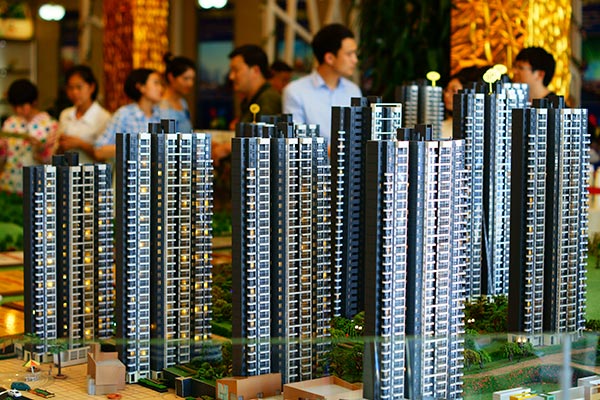
Potential homebuyers examine a property project model in Yichang, Hubei province, June 4, 2016.[Photo/VCG] |
A period of cooling home prices is expected in second half of year, think tank report says
China's housing sales are expected to reach a record high in 2016, though the growth of real estate investment may slow, said a report by a research group of the Chinese Academy of Social Sciences.
After a short-term slump, China's real estate market has been rising since mid-2015, heating up rapidly in the first quarter this year.
According to the report, housing inventory in the first half of 2016 fell by 50 million square meters from the same period in 2015, but the growth in sales slowed slightly in May.
The report sees China's real estate market having a short adjustment period from the second half of 2016 to the first half of 2017.
During this period, price increases will slow if there's no drastic change in the macroeconomic situation and in major policies, the report said.
"The cycle for China's real estate market is about two to three years, within which the rising period only lasts about one year," said Ni Pengfei, a researcher at the National Academy of Economic Strategy at CASS and the main author of the report.
"By the middle of 2016 the one-year period of increasing prices will end."
Zhang Ming, a researcher at the Institute of World Economics and Politics, said the upcoming year will be a transition from price increases to a decline in housing prices.
The report suggested that policymakers should aim to avoid drastic adjustments and maintain long-term, sustainable and stable development of the real estate market.
In particular, authorities should promote a reduction in inventory, guarantee stable prices, change the imbalance between supply and demand in various areas and prevent financing risks in the real estate market.
Among these tasks, reducing inventory in the third- and fourth-tier cities is regarded as difficult.
"The third- and fourth-tier cities also implemented destocking policies," said Ni, "but their pace was much slower than first- and second-tier cities because they increased the supply of land and promoted real estate investment at the same time as they were reducing inventory due to the pressure of local fiscal revenue and economic growth."
The report suggested restricting land and housing supplies in third- and fourth-tier cities to reduce housing inventory.


Copyright 1995 - . All rights reserved. The content (including but not limited to text, photo, multimedia information, etc) published in this site belongs to China Daily Information Co (CDIC). Without written authorization from CDIC, such content shall not be republished or used in any form. Note: Browsers with 1024*768 or higher resolution are suggested for this site.
License for publishing multimedia online 0108263 Registration Number: 130349