BEIJING - Experts have warned of stronger downward pressure and recommended policy tools to cushion shocks as China's economy confronts challenges such as slowing investment, high debt and weak exports.
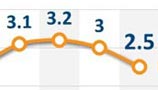
China's gross domestic product (GDP) expanded 6.7 percent in the first quarter, the slowest reading since the global financial crisis in early 2009. Experts with Renmin University of China estimated in a report the economy would expand 6.6 percent annually this year, 0.3 percentage points lower than last year.
Liu Yuanchun, an economist at Renmin University of China, said although the economy steadied earlier this year, downward pressure will weigh due to a volatile overseas outlook and rising financial risks. Structural reform will also increase the pain.
The report observed that the world's second largest economy will reach a bottom between late 2016 and early 2017.
Li Daokui, an economics professor with Tsinghua University, cautioned the investment boom will not persist, and consumer spending has shown risks. Wage growth lags behind GDP growth, and exports will not bottom out until the second half of 2017.
Authorities have predicted that China's economy will follow an L-shaped path as downward pressures weigh and new growth momentum has yet to pick up.
The central leadership is counting on supply-side structural reform, essentially cutting overcapacity, reducing stockpiles and de-levering, to address economic woes.
Proposed by policymakers in November, the reforms are generally regarded as a harder path, but a more sustainable one.
The Bank of China's chief economist Cao Yuanzheng said that if cutting overcapacity, reducing stockpiles and de-levering happen at the same time, the economy and the financial system might not be able to withstand the multiple shocks brought by these activities.
The Renmin University report advised the authorities to close "zombie" businesses and restructure debt-laden companies, while maintaining relatively easy monetary policy to shore up growth.
Fixed-asset investment, once the core engine of China's breakneck growth, cooled in the first five months. However, private investment is cooling, revealing pessimism over the economic outlook.
Data released by the National Bureau of Statistics showed that from January to May, private investment grew 3.9 percent, 1.3 percentage points lower than in the first four months. Private investment accounts for only 62 percent of the nation's aggregate investment, 3.4 percentage points lower than the same period a year ago.
Li Daokui said the sagging private investment in the first quarter should not be overstated, as it may be the result of a recent landmark tax reform, which gives government less leverage in persuading the private sector to invest more in exchange for tax incentives.
Gu Shengzu, a member of the Financial and Economic Affairs Committee of the National People's Congress, said the government should open more sectors to private business and further liberalize their access to financial resources.
In the next five years, sectors including urban development, high-end manufacturing and energy conservation still provide ample opportunities for private business, he added.


Copyright 1995 - . All rights reserved. The content (including but not limited to text, photo, multimedia information, etc) published in this site belongs to China Daily Information Co (CDIC). Without written authorization from CDIC, such content shall not be republished or used in any form. Note: Browsers with 1024*768 or higher resolution are suggested for this site.
License for publishing multimedia online 0108263 Registration Number: 130349