 |
|
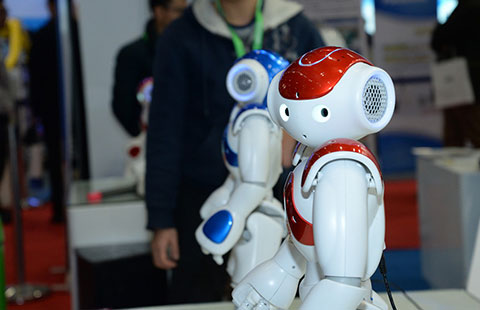
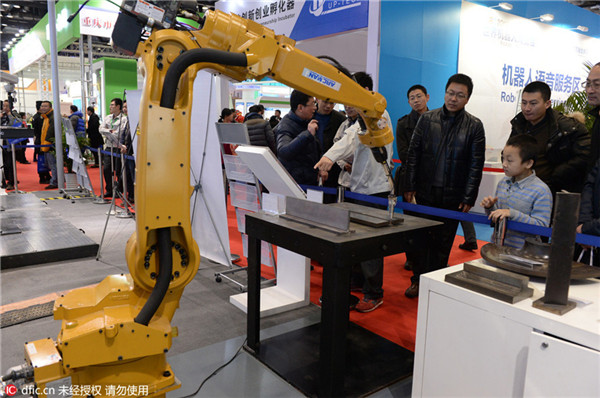
An arc welding robot is displayed at the World Robot Conference 2015 in Beijing, on Nov 24, 2015. [Photo/IC] |
BEIJING - The SAIC-GM automobile production floor in Shanghai might remind you of the movie "Transformers."
Giant yellow robotic arms are busy welding parts. The whole car body can be assembled by these robotic arms and human employees just sit in front of computer screens and type in instructions.
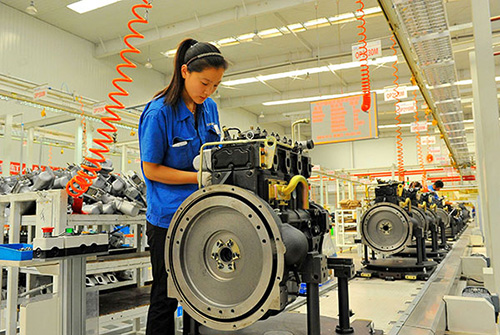
China's auto industry was quick to take up automation, but other industries are rapidly catching up. From assembling keyboards to sticking on labels, factories across China are replacing workers with robots in the ongoing government-backed, automation-driven industrial revolution.
With costs rising and profits shrinking, Chinese manufacturers have realized that they have to transition from the current labor-oriented mode to automation to survive and thrive as the population ages.
Improving quality, reducing costs, lifting productivity and ensuring sustainable growth are the eternal pursuits for manufacturers and the key is in technology. Robots can help factories achieve this, according to Gu Chunyuan, head of China business with ABB Group, a global leader in robotics.
Once the "world's factory," China is experiencing slower growth, especially in the manufacturing sector amid tepid global demand. The government rolled out an ambitious plan last year to upgrade the manufacturing sector to move upward along the global industrial chain and boost economic growth.
The application of new industrial systems, including robotics, will help improve enterprises' productivity by up to 25 percent, creating added value worth 6 trillion yuan ($91.4 million), according to recent research by Boston Consulting Group (BCG).
The central leadership called for a "robot revolution" last year in acknowledgement of automation's vital role in raising productivity. Authorities have announced measures such as subsidies and tax incentives over the past few years to encourage industrial automation as well as development of the domestic robotics industry.
The Ministry of Industry and Information Technology (MIIT) in April released a development blueprint for robotics-market growth in the next five years, which aims to have about 800,000 robots in stock by 2020 and achieve breakthroughs in high-end robots in areas such as surgery or nursing.
Since 2013, China has bought more industrial robots each year than any other country and is expected to be the world's biggest operator of industrial robots in 2018, according to the International Federation of Robotics.
There is plenty more room for market growth. China has about 36 robots for every 10,000 factory workers compared with about 478 in the Republic of Korea and 164 in the United States, according to MIT Technology Review.
China is home to about 800 companies producing or assembling robots, however, most of them only make low-end products.
We have noticed trends of low-tech utilization and development of robots in the sector, and the industry might be flushed with inefficient investment, according to Xin Guobin, deputy head with MIIT.
Chinese companies are taking action to catch up with global pioneers. Agic Capital, the Chinese-European private equity fund launched last year, bought Gimatic, an Italian supplier of robotic end-of-arm tools, in mid June. Midea, a Guangdong-based appliance maker launched a 4.5 billion euros offer this month for Kuka, a globally renowned robot producer that serves customers such as Audi, BMW and Boeing.


Copyright 1995 - . All rights reserved. The content (including but not limited to text, photo, multimedia information, etc) published in this site belongs to China Daily Information Co (CDIC). Without written authorization from CDIC, such content shall not be republished or used in any form. Note: Browsers with 1024*768 or higher resolution are suggested for this site.
License for publishing multimedia online 0108263 Registration Number: 130349