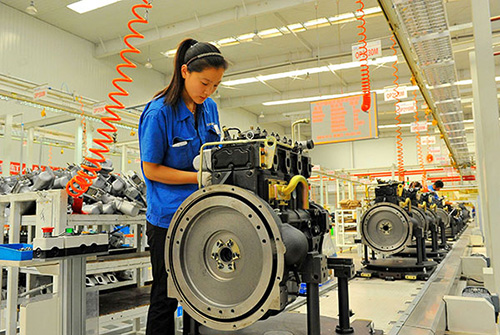
Nestle SA and Alibaba Group hold a ceremony on Sunday in Beijing to celebrate the establishment of their partnership. [Photo/Xinhua]
Food giant hopes move will help revitalize performance in China

Nestle SA and Alibaba Group Holding Ltd have launched a digital commerce and marketing campaign, a move the Swiss food giant hopes will boost its disappointing business in China through innovation in products and digital distribution channels.
The six-month joint campaign will leverage Alibaba's online and mobile marketplaces, media platform and rural services.
According to Nestle, it will feature 154 products from 30 brands, 67 of which will be introduced to Chinese consumers for the first time.
Nestle's growth had been slowing in the past few years in China, as the company said it has not reacted quickly enough to trends like e-commerce and healthier eating.
Nestle said its Chinese Yinlu congee brand still faces challenges as consumers shift to more premium products.
"Consumers in China are very discerning and adapting to technology faster than almost anywhere else in the world," said Wan Ling Martello, executive vice-president responsible for Nestle's Asia, Oceania and sub-Saharan Africa regions who is also on Alibaba's board.
Martello said at an investment meeting in May that despite the slowdown in Chinese economy and the country's fast-moving consumer goods sector, the country remains a great consumer story thanks to its emerging middle class and their growing disposable income.
But she said its driving force is innovation and technology through building new competency-dealing with new challenges in digital distribution-instead of traditional bricks-and-mortar stores. Nestle's research has found that more than 75 percent of consumers use the internet to browse or buy. It has also found that 80 percent of shoppers give reviews online, with more than 50 percent of purchase decisions being made online.
The company set up a standalone e-commerce unit in China a few years ago that is independent of its traditional business. The company's e-commerce business in China is expanding at triple-digit rates, and is on average more profitable than its bricks-and-mortar retail operations, according to Bloomberg.
According to Kantar Worldpanel, despite the overall fast-moving consumer goods market slowdown at 3.5 percent in 2015, the e-commerce sector remained a bright spot and grew by 36.5 percent.
China remains the world's biggest e-commerce market, and online penetration still reported double-digit growth, according to researches. While e-commerce has already become an established shopping channel in big cities in China, it still has vast potential to grow in smaller cities and rural areas, experts said.
Most multinational brands such as Nestle has been relying on previous growth through expanding their penetration in hypermarkets and supermarkets in the past decade. But Jason Yu, general manager of Kantar Worldpanel China, said they are relatively weaker in penetration in smaller cities because of the vast geographic complexity of China.
Leveraging powerful e-commerce platforms like Alibaba's Tmall will help the brands overcome barriers to building distribution, making their products immediately accessible to consumers in smaller cities, said Yu.


Copyright 1995 - . All rights reserved. The content (including but not limited to text, photo, multimedia information, etc) published in this site belongs to China Daily Information Co (CDIC). Without written authorization from CDIC, such content shall not be republished or used in any form. Note: Browsers with 1024*768 or higher resolution are suggested for this site.
License for publishing multimedia online 0108263 Registration Number: 130349