 |
|
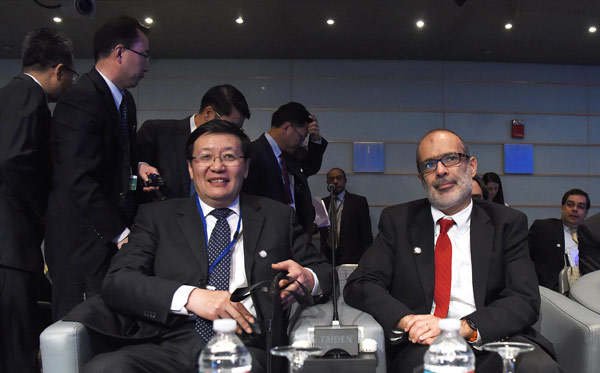
Finance Minister Lou Jiwei (left) with fellow participants at the inaugural Global Infrastructure Forum in Washington on Saturday. Yin Bogu / Xinhua |
China is well on the road to eradicating poverty, according to Minister of Finance Lou Jiwei.
In a keynote speech to the inaugural Global Infrastructure Forum in Washington on Saturday, he said the country is making great strides in improving living standards through infrastructure.
"We have a saying that if you want to get rich, build roads first," Lou said. "Roads represent infrastructure.
"China's power grid is now extended to all the rural villages," he added. "In two years, we'll ensure people have access to safe drinking water in every village. And in three years, we will have fourth-generation wireless networks in rural areas. We will also help relocate farmers in inhospitable places, to reduce poverty."
The Global Infrastructure Forum convened the leaders of multilateral development banks, including Jin Liqun, president of the Asian Infrastructure Investment Bank, which was formally established this year.
"The conceptualization of (the AIIB) is based on the development experience of China and other developing countries over the past two or three decades," Jin said. "We believe infrastructure investment can pave the way for broad-based economic social developments."
On April 13, Jin and Jim Yong-kim, president of the World Bank, signed the first financing framework agreement between their institutions, outlining the parameters of joint investment projects.
Jin said similar agreements are expected to be signed with the Asian Development Bank and European Investment Bank, among others.
"We all understand that, without combined concerted efforts, it's very hard for us to meet the needs of Asia and other developing regions," he said. "At most, all of these banks can only meet probably about 10 percent of the $1.5 trillion needed every year. That's why we need to work together and to mobilize private-sector resources."
The forum's aim is to better align and coordinate partners, while respecting the diversity of approaches, policies and procedures to facilitate the development of sustainable, accessible and resilient infrastructure in developing countries.
"If we are to achieve our goals and leave no one behind, we must address large infrastructure gaps in developing countries," said Ban Ki-moon, secretary-general of the United Nations. "Developing countries, particularly the most vulnerable, need international support to bridge infrastructural gaps."
Lou said G20 members have reached a consensus to encourage multilateral development banks to invest more in infrastructure. "G20 countries have high expectations and will give very strong support to these banks to move forward in infrastructure investment," he said.
Allan Fong in Washington contributed to this story.


Copyright 1995 - . All rights reserved. The content (including but not limited to text, photo, multimedia information, etc) published in this site belongs to China Daily Information Co (CDIC). Without written authorization from CDIC, such content shall not be republished or used in any form. Note: Browsers with 1024*768 or higher resolution are suggested for this site.
License for publishing multimedia online 0108263 Registration Number: 130349