 |
|
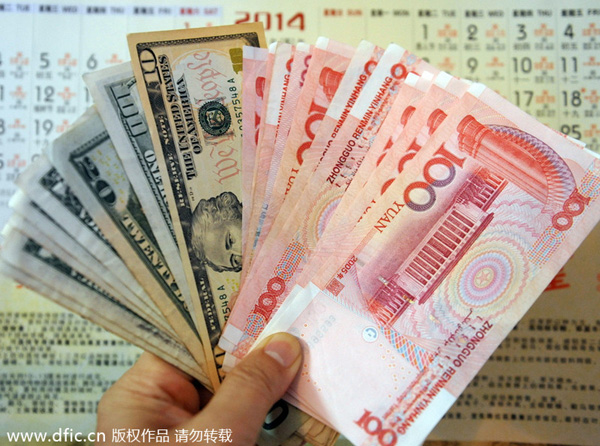
A Chinese resident displays his Chinese currency and US dollar banknotes in Qionghai city, South China's Hainan province, March 15, 2014. [Photo/IC] |
Accelerated capital outflow in the past year resulted in record high net sales of $465.9 billion in foreign exchange from banks on the Chinese mainland, the central government reported on Thursday.
The State Administration of Foreign Exchange, China's top currency trade regulator, said the volume of the capital outflow was in part brought on by the US Federal Reserve raising interest rates.
The SAFE said the outflow is still manageable and cannot threaten the overall health of the financial system.
In December, mainland banks reported net sales of $89.4 billion in foreign exchange, showing the third-largest deficit-or proportion of sales to purchases-of foreign currency on record.
In contrast, it showed a surplus of $125.8 billion in 2014 and $270.2 billion in 2013 in large capital inflows.
SAFE spokeswoman Wang Chunying said on Thursday that the Fed's increase of the interest rate accelerated capital outflows from China and other emerging economies. "But we are better prepared than some emerging countries to resist external shocks." However, economists expected the capital outflows to continue in 2016, as there have been no signs of reduced downward pressure on economic growth after GDP hit a 25-year low of 6.9 percent, and the renminbi may further depreciate against the US dollar.
Louis Kuijs, an economist at Oxford Economics, a commercial venture with Oxford University's business college predicted that the renminbi will further weaken by 3.5 percent to 6.8 yuan per US dollar by the third quarter this year. "Capital outflows will continue to exert downward pressure on the currency," he said.
Along with the dramatic capital outflows, Chinese foreign exchange reserves sharply decreased by $512.7 billion last year, to $3.33 trillion-though it remains the world's largest foreign reserves.
According to the SAFE, $253.8 of the reduction in the reserves was from Chinese non-banking enterprises and individuals, coming from direct overseas investment, overseas equity investment under the Qualified Domestic Institutional Investor scheme, repayment of foreign debt and outbound tourism and consumption.
The central bank's sale of foreign exchange on the currency market to stabilize the renminbi's exchange rate also contributed to the decline, the SAFE said without disclosing the specific amount.
"So far, the amount of China's foreign exchange reserve is sufficient and strong enough to resist shocks from overseas," the SAFE spokeswoman said.
Li Daokui, an economics professor at Tsinghua University, said earlier that at least $3 trillion foreign exchange reserves in China is required to prevent foreign debt default risk.
A research note from Barclay's Capital predicted that the minimum foreign exchange reserves should remain at $2.75 trillion.

Copyright 1995 - . All rights reserved. The content (including but not limited to text, photo, multimedia information, etc) published in this site belongs to China Daily Information Co (CDIC). Without written authorization from CDIC, such content shall not be republished or used in any form. Note: Browsers with 1024*768 or higher resolution are suggested for this site.
License for publishing multimedia online 0108263 Registration Number: 130349