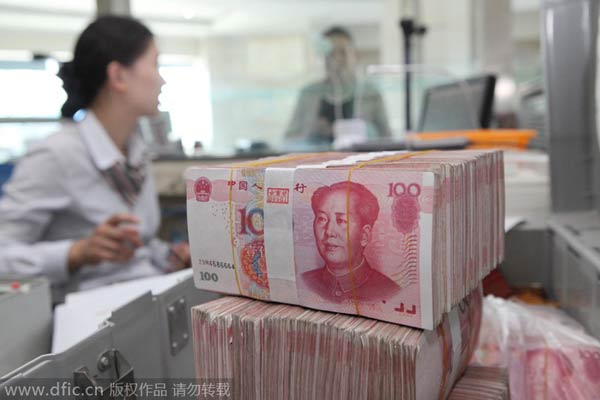
An employee counts renminbi (yuan) banknotes at a bank in Lianyungang city, East China's Jiangsu province, June 4, 2014.[Photo / IC]
PBOC unveils more steps to stabilize currency amid capital outflows
This new regulation will come into effect on Jan 25, the PBOC said in a statement on Monday. Until now, the reserve requirement ratio for overseas banks, or the amount of depositor funds they must keep aside, is zero. For major financial institutions on the mainland the RRR is 17.5 percent of their total deposit.
Foreign central banks, sovereign wealth funds and international financial organizations will not come under the purview of the new requirement, said the statement.
The step is a long-term mechanism that regulates cross-border yuan-denominated funds flows and avoids irrational and speculative sell-offs of the currency, according to the PBOC.
"The measure will strengthen liquidity management and prevent financial crises," it said.
According to Guotai Junan Securities Co and Haitong Securities Co, more than 220 billion yuan ($33.4 billion) of funds will be frozen, and it will tighten the renminbi supply in the offshore market and make it more expensive for speculators' short selling.
Renminbi traded in Hong Kong rose more than 0.4 percent to 6.5868 yuan per US dollar after the central bank's announcement, its strongest since Jan 11.
The central bank lifted the daily trading reference exchange rate by 0.07 percent on Monday to 6.559 yuan per US dollar, the largest daily appreciation in four weeks.
Joey Chew, Asian foreign exchange strategist at HSBC Holdings Plc, said: "We believe China is sending a strong message to speculators and trying to stabilize renminbi depreciation expectations."
In the Hong Kong interbank market, the cost of borrowing renminbi for a week, or the 7-day CNH Hibor rate, surged by 370 basis points to 11.9 percent on Monday, while the one-month rate rose by 251 basis points to 11.84 percent.
An even more dramatic tightening of foreign exchange liquidity happened in the offshore market last week. The overnight CNH Hibor rate rose to 66.8 percent on Wednesday, when the market speculated that the PBOC had strengthened intervention by selling US dollars.
The currency's value depreciated by about 1.5 percent during the first week of 2016, increasing global investors' concern that the Chinese government may face further cooling risks and the strengthening US dollar may lead to more global capital flowing out of China.
Chang Jian, chief economist in China at Barclays Capital, said: "A less costly alternative would be a tightening of capital controls to prevent faster-than-expected decline in foreign reserves." "However, the government would need to consider this option carefully, given its broader agenda of renminbi internationalization and capital account liberalization," she said.

Copyright 1995 - . All rights reserved. The content (including but not limited to text, photo, multimedia information, etc) published in this site belongs to China Daily Information Co (CDIC). Without written authorization from CDIC, such content shall not be republished or used in any form. Note: Browsers with 1024*768 or higher resolution are suggested for this site.
License for publishing multimedia online 0108263 Registration Number: 130349