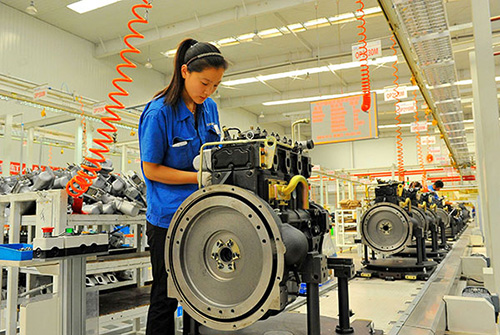
BEIJING - Once the turbo-charger powering China's economic acceleration, the manufacturing sector is now in dire need of a service.
China has made economic structuring its top priority for the next five years, and at the heart of that mission is tackling overcapacity and corporate debt, according to a statement released after this year's Central Economic Work Conference, held at the end of each year to chart the course for the next year.
Corporate debt equaled 150 percent of GDP in the first quarter of this year, according to rating agency Moody's. The debt is worst in sectors saddled with overcapacity, such as steel, coal and cement. Their debt alone accounts for about 10 percent of the total.
Rating agency Standard and Poor's warned investors in a recent report that such high leverage is something they should be aware of in the coming year. Metals, mining, property developers, transport and building materials are increasingly vulnerable to defaults as debt mounts and stockpiles grow.
Debt among Chinese issuers is now five times their earnings before interest, taxes and amortization; almost twice as much as it was at the end of 2008. Rising debt loads and unwanted goods sitting in warehouses have weighed on investment growth, which dropped by about 50 percent in the first 11 months.
That weakness, economists say, will extend into next year with uncertain prospects for property investment and a continuing struggle in the manufacturing sector.
For years, addressing overcapacity and deleveraging have been widely recognized as the most pressing tasks, but in reality stabilizing growth takes precedence. The economy slowed to a six-year low during the first three quarter this year, but still hovers "around 7 percent."
In Hebei, the province surrounding Beijing, steel production fell by only 6 million tons in the first 11 months, with cuts of unlikely further 54 million tons promised by the end of 2017. Another 20 million tons of cuts will be found elsewhere in the country.
Hebei's cement and glass production also dropped in the same period, also marginally, by 5.8 percent and 3.6 percent respectively.
Despite the often-stated commitment to cut overcapacity and debt, fixing these problems will take a long time and will take consistency of policy over many different departments to avoid social and economic repercussions.
The government will have a busy year addressing overcapacity, said Goldman Sachs China economist Song Yu, but "limiting spillover of industry weakness to consumption via the labor market or financial sector" is just as important, and every bit as difficult. The slowdown in investment came against relatively resilient growth in services and consumption, underpinned by stable employment and income growth.
The government's target of creating 10 million jobs this year was accomplished by the end of the third quarter and the growth of household incomes has been outpacing GDP growth for several quarters.

Copyright 1995 - . All rights reserved. The content (including but not limited to text, photo, multimedia information, etc) published in this site belongs to China Daily Information Co (CDIC). Without written authorization from CDIC, such content shall not be republished or used in any form. Note: Browsers with 1024*768 or higher resolution are suggested for this site.
License for publishing multimedia online 0108263 Registration Number: 130349