 |
|
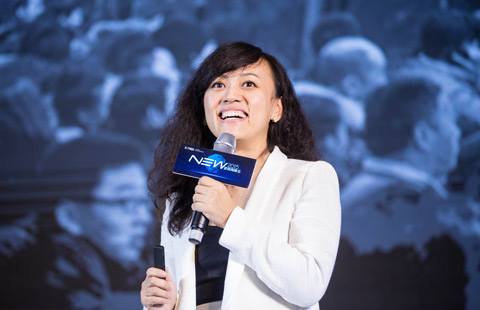
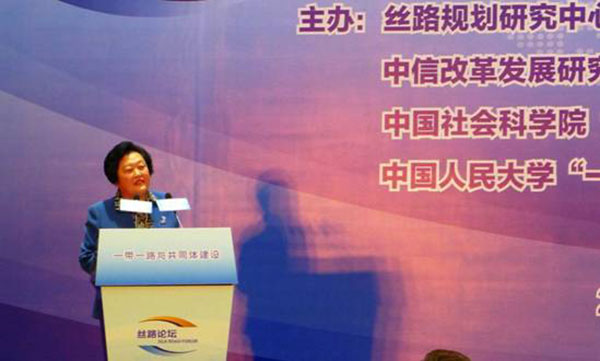
Zhao Baige, member of NPC Standing Committee, Vice Chair of the Foreign Affairs Committee of NPC, delivers a keynote speech at the Silk Road Forum, Nov 6, 2015.[Provided to chinadaily.com.cn] |
In the afternoon of Nov 6, 2015, Zhao Baige, member of NPC Standing Committee, Vice Chair of the Foreign Affairs Committee of NPC and Chair of Advisory Committee of CASS-RDI delivered a keynote speech entitled Establishing a New-type Think Tank Platform, Pooling Resources to Develop "One Belt One Road" Community at the "One Belt One Road and Community Building" Silk Road Forum, elaborating on the significance of implementing the "One Belt One Road" Initiative as well as how to build and realize such a community.
According to Zhao, there are two key points in understanding the significance of the "One Belt One Road" Initiative. First, the "One Belt One Road" Initiative will bring about improvements of global governance architecture in the new historical period. The "One Belt One Road" Initiative is the most important carrier of globalization. It will urge all countries to participate and achieve development in a fair and equal manner. Since the end of Second World War, the global governance architecture has been in control of some countries. But in this era of globalization, global governance should be participated by more countries, especially developing countries. Without the comprehensive development of each and every country, of each and every human being, the quality of development is questionable. One of the great significances of the "One Belt One Road" Initiative, therefore, is to let all of us participate in global governance. Global governance entails not only economic development, but also politics, social, cultural and ecological development and so on.
Second, the "One Belt One Road" Initiative will cultivate new areas of economic growth around the world. When people talk about globalization, particularly economic globalization, more often than not there are some countries and populations being neglected. This indicates imbalance during the global economic development process. This widening gap not only resulted in disparity and inequality among regions, but also posed challenges to building a harmonious society. In September 2015, the United Nations set the Sustainable Development Goals, which becomes important guidance for the millennium global development. The principles, contents and objectives of the "One Belt One Road" Initiative are highly compatible to the UN Charter and Sustainable Development Goals. That is why we believe that the great significance of the "One Belt One Road" Initiative lies not only in its due role in economic globalization, but also in its role in promoting global peace and development. The "One Belt One Road" Initiative will make enormous contributions to meeting the challenges of the 21st century.
When talking about the building of a community, Zhao said that when first putting forward the grand design of the "One Belt One Road" Initiative, Chinese President Xi Jinping had mentioned the principles of "mutual consultation", "mutual implementation" and "mutual sharing". First, "mutual consultation" means that countries and regions along the "One Belt One Road" shall reach a consensus on development goals, and discuss together the processes of and approaches to achieving these goals. This is not exactly the same as many decision-making processes in the past. Some important matters are often discussed on certain international events and not all developing countries have the opportunity to fully express their aspirations and viewpoints. The "One Belt One Road" Initiative will offer a platform for equal consultation to all developing countries, including China. For example, we have initiated the cooperation between China and Pakistan. The project’s implementation, finance, and construction plans are not determined by China alone, but by a community formed in accordance with needs. Mutual consultation is the most important step in building a community.
Second, mutually implementing the "One Belt One Road" Initiative is not a hierarchical charity from A to B. Instead, it is to create a community of common destiny, responsibility and interests. Development among various countries must be established on the basis of the mutual principle of joint consultation, joint construction and joint sharing. Recently, France and China has worked together to provide support to the construction of nuclear power stations in the United Kingdom. This is a representative case. The so-called "North-South-North" Cooperation is a mode of cooperation among two developed countries and one of the biggest developing countries. What we adopted in Pakistan is a "South-North-South" Cooperation mode. China makes active promotions and references to the standards, technologies, norms and experiences of EU countries, so as to promote the long-term development of Pakistan.
Third, the outcomes of the "One Belt One Road" Initiative should be mutually shared by all the people of countries along the routes. The "One Belt One Road" Initiative is a very effective carrier for globalization. Along the "One Belt One Road", there are 65 countries with a total population of about 4.4 billion and an aggregate GDP of approximately $21 trillion. The "One Belt One Road" Initiative is compatible with the common needs of countries along the routes. It opens the window of new opportunities for these countries in complementary cooperation, opening-up and development. It is a new platform for international cooperation, so that the interests and outcomes must be shared by all the people.
As for the current points of attention, Zhao reckons that the most important thing is action, action, and action. If a concept has been discussed for a long time without any subsequent action, it may have negative impacts on the "One Belt One Road" Initiative. Therefore, we must first pool all valuable governmental, market and social resources to serve the grand goals of the Belt and Road Initiative.

Copyright 1995 - . All rights reserved. The content (including but not limited to text, photo, multimedia information, etc) published in this site belongs to China Daily Information Co (CDIC). Without written authorization from CDIC, such content shall not be republished or used in any form. Note: Browsers with 1024*768 or higher resolution are suggested for this site.
License for publishing multimedia online 0108263 Registration Number: 130349