 |
|
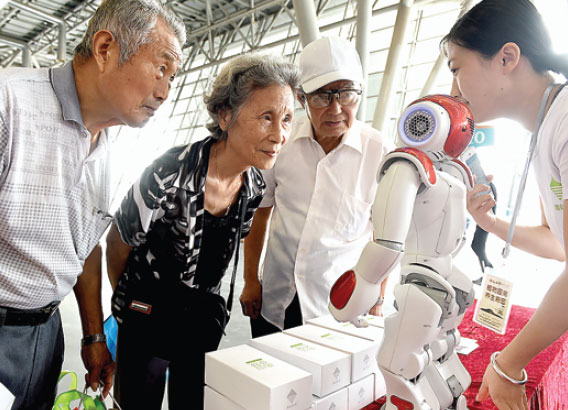
Visitors examine a robot designed to serve the elderly at an expo in Anhui province, on Aug 14. [Photo/Xinhua] |
Job makers or breakers?
The fact that robots-which don't require air-conditioned offices, paid vacations or frequent salary raises-appear to be ideal employees and few humans can hope to compete with them, naturally raises another question: What if robots perform so well that humans become redundant and unemployment rises?
Industry experts said that such a scenario is improbable. "It's unlikely that there will be a conflict between the installation of robots and employment levels in China in the next five years," Qu Daokui, president of Siasun Robot & Automation Co, said.
Qu said the application of industry robots is limited to only a few fields such as welding, hauling and stacking-repetitive, strenuous manual labor that few people wish to do-so using robots to replace the humans currently engaged in these tasks is unlikely to affect the employment rate.
Statistics released by the International Federation of Robotics shows that the major applications for industrial robots include handling, welding, assembly, dispensing, processing and "clean room" work in dust-free environments.
Although most of the robots are used on automobile production lines (38 percent) and the manufacturing of electronic products (27.6 percent), they are also gradually being adopted by traditionally labor-intensive industries, such as foodstuffs and plastic wares, sectors that have suffered most from the labor shortage in recent years.
"From Germany to South Korea to China, a direct factor in employment has been the economic cycle of a country, not the rising number of robots being installed," Qu said.
Wang Yuechao, director of the Bureau of Major R&D Programs at the Chinese Academy of Sciences, said that based on current technology, robots are unable to perform complex tasks that are currently undertaken by senior skilled workers.
"A six-joint robot is already the most sophisticated thing that engineers can build using the current available technology, but its flexibility doesn't compare with our hands at all," Wang said. "So the range of jobs in which robots will replace humans is too narrow to threaten overall employment levels."
Moreover, a report by the International Federation of Robotics said a prosperous robotics industry could created 1 million to 2 million jobs between 2017 and 2020.
"Our study proves that robots create jobs," said Gudrun Litzenberger, general secretary of the federation, in a written statement.

Copyright 1995 - . All rights reserved. The content (including but not limited to text, photo, multimedia information, etc) published in this site belongs to China Daily Information Co (CDIC). Without written authorization from CDIC, such content shall not be republished or used in any form. Note: Browsers with 1024*768 or higher resolution are suggested for this site.
License for publishing multimedia online 0108263 Registration Number: 130349