 |
|
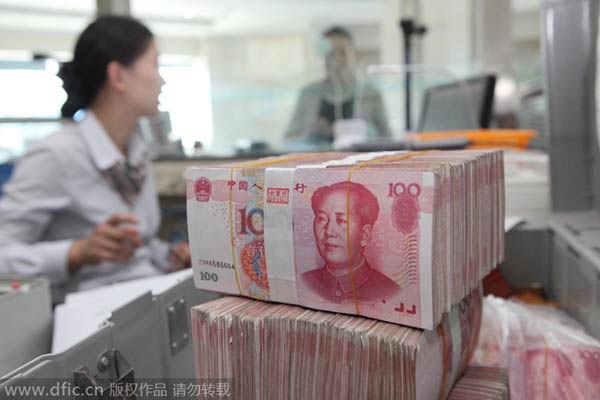
An employee counts renminbi (yuan) banknotes at a bank in Lianyungang city, East China's Jiangsu province, June 4, 2014.[Photo/IC] |
Motion will keep borrowing within local governments' ability to repay
For the first time in China's modern history, the national legislature has introduced a "debt ceiling" for local government debt, setting it at 16 trillion yuan (more than $2.5 trillion) for this year.
This decision was made on Saturday when the National People's Congress Standing Committee approved a motion proposed by the State Council, or Cabinet.
Observers say this may be the first move by the central government to set a quota system for the debt that is allowed for the governments of all provinces, municipalities and autonomous regions.
China's new Budget Law, which took effect this year, also allows local governments to raise part of their funds for development purposes through the issuance of local bonds. But the size of such issuances is subject to NPC approval.
According to Lou Jiwei, the minister of finance, the NPC's decision makes clear that local debts can never exceed 100 percent of a local economy's wealth-generating capability-as measured by their fiscal revenue.
It also clarifies that a high-risk warning is warranted once local debts range between 80 percent and 120 percent of local fiscal revenues.
Lou estimated that with a total debt of 16 trillion yuan, China's local debt ratio would hover around 86 percent, or a high-risk level, at the end of the year.
But Bai Jingming, a researcher at the Ministry of Finance, said such a degree of risk is still largely manageable, although some local governments would inevitably face more difficulties than others.
Liu Jianwen, a professor of finance and law at Peking University, said managing the recent runaway local government debt is one important task for China's ongoing economic transition. The quota system will force local governments to become more responsible for their spending and fundraising activities.
Of the 16 trillion yuan local debt, 15.4 trillion yuan is debts that local governments will have to take full responsibility for repaying, according to a survey at the end of last year by the National Development and Reform Commission, the People's Bank of China and the China Banking Regulatory Commission.
In comparison with a survey in late June 2013, the figure has increased by more than 40 percent.
Wang Dehua, an economist at the Chinese Academy of Social Sciences, said such a high increase in local debts is due to the introduction of a large number of major public infrastructure projects by local governments.
As for housing development borrowing by companies with ties to local officials, the State Council has already made it clear that local governments are responsible for their debts.

Copyright 1995 - . All rights reserved. The content (including but not limited to text, photo, multimedia information, etc) published in this site belongs to China Daily Information Co (CDIC). Without written authorization from CDIC, such content shall not be republished or used in any form. Note: Browsers with 1024*768 or higher resolution are suggested for this site.
License for publishing multimedia online 0108263 Registration Number: 130349