 |
|
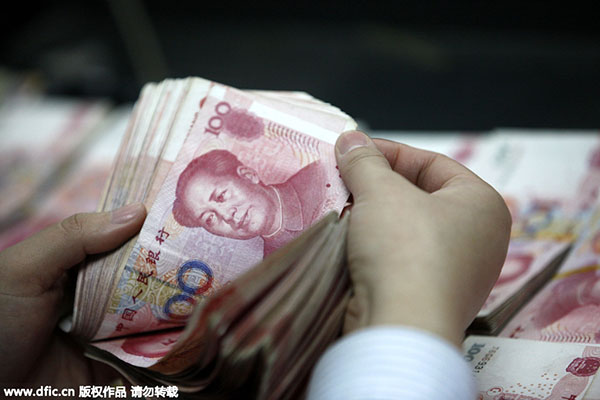
A Chinese clerk counts RMB (renminbi) yuan banknotes at a bank in Huaibei city, East China's Anhui province, January 22, 2015.[Photo/IC] |
BEIJING -- China's currency fell sharply in value on Tuesday following the central bank's decision to improve its "central parity system" to better reflect market development in the exchange rate between the Chinese yuan against the US dollar.
Effective beginning Tuesday, daily central parity quotes reported to the China Foreign Exchange Trade System before the market opens should be based on the closing rate of the inter-bank foreign exchange rate market on the previous day, supply and demand in the market, and price movement of major currencies, the People's Bank of China (PBOC) said.
The PBOC cited a strong US dollar and sharp appreciation in the RMB real effective exchange rate as key considerations behind the policy change.
The PBOC said the RMB's central parity has deviated from its actual market rate "by a large extent and for a long duration," which has "undermined the authority and the benchmark status" of the central parity system.
Following the change, the central parity rate of the yuan weakened sharply to 6.2298 against the US dollar compared to 6.1162 on Monday, down nearly 2 percent, a record low since April, 2013.
More market-oriented
Tuesday's sharply lower rate has been described by the PBOC as a "one-off" adjustment, which has bridged the previously accumulated differences between the central parity rate and the market rate.
The central bank said it would closely monitor market movements in the future to stabilize market expectations and make sure the new exchange rate formation system works effectively.
The PBOC vowed more efforts to promote foreign exchange reform -- make it more "market-oriented", open up foreign exchange market further with inclusion of qualified foreign entities and gradually unite onshore-offshore RMB exchange rate.
China's foreign exchange reform officially started in July 2005 when the central bank decided to unpeg the yuan against the U.S. dollar and allowed it to fluctuate against a basket of currencies. The yuan was allowed to rise or fall by 0.3 percent from the central parity rate each trading day in China's spot foreign exchange market.
The trading band expanded to 2 percent since March last year, with the market expecting it to expand to 3 percent in the near future.
Analysts believe the central bank's policy will allow market forces more sway in exchange rate determination and help China to send the RMB into the benchmark currency basket of the International Monetary Fund (IMF).
"Today's move is likely intended to improve the 'market-driven ' quality of the PBOC daily fix, so that it can qualify to be used by the IMF as a Special Drawing Rights (SDR) reference rate," said Wang Tao, chief China Economist at UBS.
Wang expects the USD-CNY exchange rate to be around 6.5 by the end of 2015, up from his previous forecast of 6.3.

Copyright 1995 - . All rights reserved. The content (including but not limited to text, photo, multimedia information, etc) published in this site belongs to China Daily Information Co (CDIC). Without written authorization from CDIC, such content shall not be republished or used in any form. Note: Browsers with 1024*768 or higher resolution are suggested for this site.
License for publishing multimedia online 0108263 Registration Number: 130349