 |
|
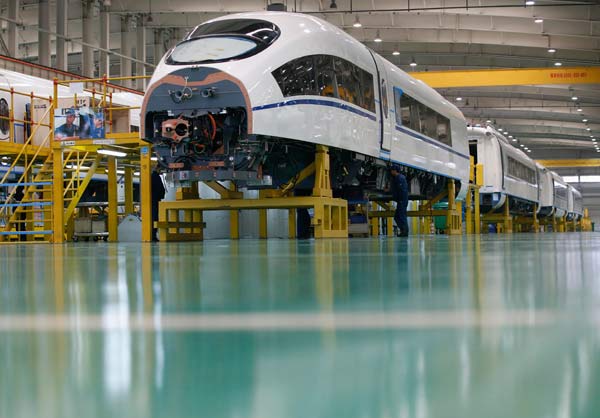
A CRH train that runs on Lanzhou-Urumqi High-Speed Railway stops at Urumqi South Railway Station in Urumqi, Xinjiang Uygur autonomous region, Dec 26, 2014. [Photo/Xinhua] |
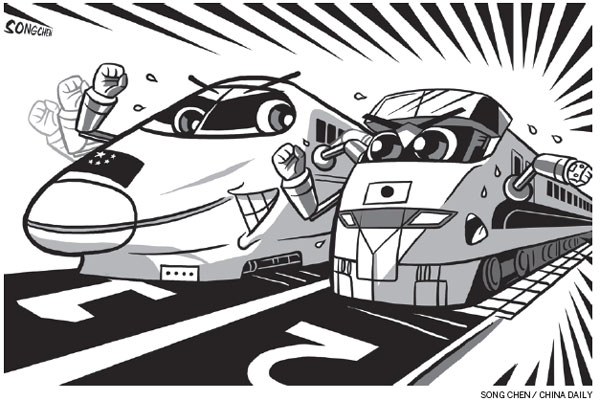
Media reports suggest Japanese Prime Minister Shinzo Abe will try to promote Shinkansen bullet train technology during his visit to the United States (which started on April 26) to cash in on the US' plans to prop up its economy with high-speed railway.
Obviously, Japan is competing with China to get a share of the high-speed train market in US and some other countries. So which country has the upper hand?
China may be a latecomer in high-speed train construction, but some of its technologies are better than other countries'. For example, one exquisite technological requirement is that the surface of the rails that touches the wheels must be delicately clean while the track geometry should be smooth, because even the minutest flaw could shake a train considering its high speed. This is just one of the areas in which China excels - the rails on the Beijing-Shanghai high-speed train line are so smooth that the test train reached speeds of 380 kilometers an hour without any evident shaking.
On another technological index - degree of ride comfort - China's high-speed trains' record is good, too. Every train has to pass strict even severe tests before being pressed into service to ensure passengers enjoy the maximum comfort. Many passengers who have traveled by high-speed trains in China and Europe say the former are better. On other indexes such as dynamic safety, too, China's high-speed railways show good performance.
Besides, China's high-speed railways cost the least in the world. It is globally acknowledged that, the cost of building high-speed railways is the lowest in China. In October 2014, while bidding for the Boston subway program, China CNR Corporation Limited, despite not bagging the contract, quoted a price that was only about 60 percent that of its Japanese competitor Kawasaki Heavy Industries.
The incident prompted Japanese enterprises to accuse China of "dumping", albeit without any basis. China's high-speed railways cost less because of the low cost of labor in the country. High-speed railways require civil and electrical engineering, and all kinds of physical labor, which cost much more in a fast aging society like Japan. And therein lies China's advantage.
Also, the low cost of China's high-speed railways has a lot to do with the lower requirement of profit.
Another incomparable advantage Chinese high-speed railways have is the country's difficult geographical terrains. China has already built more than 16,000 km of high-speed railways across high plateaus, mountains, plains and deserts. Working in such terrains, Chinese engineers and workers have gained precious experience to deal with difficulties of any kind. Working together, engineers and other technical experts, and manual workers have developed a strong teamwork spirit and mutual trust.
Of course, the Japanese too have their advantages. Masaki Ogata, executive vice-chairman of East Japan Railway Company, said in a recent interview, Shinkansen technology can prevent damage to high-speed railways during earthquakes, and has advantages in environmental protection and noise control.
Indeed, Japanese high-speed railways enjoy these advantages. But China is developing its high-speed train technology fast enough to catch up with the best by, among other things, funding research teams to develop advanced monitoring and early warning systems, and quake-resistant technology to ensure the safety of high-speed railways. Even in environmental protection, China has gained enough experience while building the railway that connects Lhasa, Tibet with Qinghai province.
In short, China's high-speed railways are good in quality and competitive in price, and will definitely be better in the future.
Zhai Wanming is a chair professor at Xinan Jiaotong University and a member of the Chinese Academy of Sciences. The article is an excerpt from his interview with China Daily's Zhang Zhouxiang.
Copyright 1995 - . All rights reserved. The content (including but not limited to text, photo, multimedia information, etc) published in this site belongs to China Daily Information Co (CDIC). Without written authorization from CDIC, such content shall not be republished or used in any form. Note: Browsers with 1024*768 or higher resolution are suggested for this site.
License for publishing multimedia online 0108263 Registration Number: 130349 

