|
 |
|
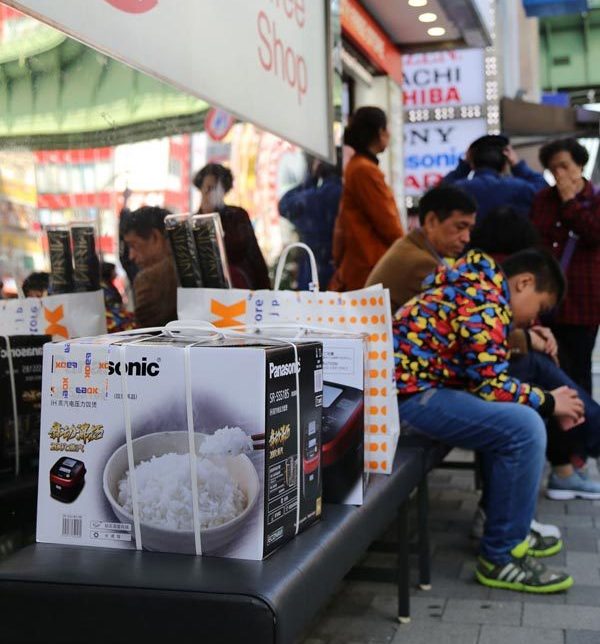
Chinese tourists take a break at a tax-free outlet in Tokyo. [Photo/China Daily] |
For Chinese tourists who have visited Japan, what has lingered in their minds after their return is not only the cherry blossom at the foot of Mount Fuji, but also the electric toilet seats and rice cookers.
The Japanese yen's depreciation, the country's expanding tax-free policy and the relaxed visa requirements for Chinese tourists have made the already popular trips to Japan a shopping spree.
During this year's cherry blossom season, from the end of March to the middle of April, Japan is expected to have received around 350,000 Chinese tourists, whose total spending is estimated at 7 billion yuan ($1.13 billion), or 20,000 yuan each person, according to Online travel agency Ctrip.
During this year's week-long Spring Festival holiday, about 450,000 Chinese tourists spent nearly 6 billion yuan in Japan, local media reported.
Small household electrical appliances are the items most sought after by Chinese tourists, such as electric toilet seats and rice cookers.
"It is a craze for Chinese people to buy decent Japanese products at lower prices than in China," said a woman surnamed Li, who returned from Japan in March with a great deal of purchases.
Many Chinese people think the same as Li. However, the gap between goods made in Japan and China is not as big as expected.
China Central Television conducted an experiment comparing the performance of Japanese and Chinese rice cookers, with both containing the same quality and amount of water and rice. Ten people were randomly selected to have a blind taste, and results showed that five chose the rice cooked by the Chinese rice cooker, and two said they failed to find any difference between the two.
And according to some indicators, the performance of domestic rice cookers is even better than Japanese ones.
A similar situation can also be seen with electric toilet seats. "China has adopted the same international standards in manufacturing as those used in Japan," said Ma Dejun, deputy director of China Household Electrical Appliances Research Institute.
The Chinese small household electrical appliance sector has developed rapidly in recent years, and has gradually squeezed out overseas goods. But Chinese-made goods mainly target the middle and lower-end markets, according to industry insiders.
For example, in 2014, the retail volume of electric rice cookers reached 43.3 million, with total sales of 13.2 billion yuan, increases of 3.3 percent and 10.9 percent year-on-year, respectively, according to market research company China Market Monitor.
Meanwhile, the country's e-commerce websites showed that the price of the top 10 rice cookers is between 100 and 300 yuan, far below the prices of those made in Japan, which normally cost thousands of yuan.
Hong Shibin, vice-president of China Household Electrical Appliances Association, said domestic companies have the ability to produce high-end rice cooker with advanced technology, but many of them didn't head into this section of the market. Besides, the long-term price war also weakens manufacturers' innovative capacity.
Yang Guangliang, president of Guangdong-based rice cooker producer Enaiter said there is quite big market space for intelligent rice cookers in China. So far, the popularity of intelligent rice cookers is less than 30 percent in China, while in Japan and South Korea, the figure is as high as 96 percent, he said.

Copyright 1995 - . All rights reserved. The content (including but not limited to text, photo, multimedia information, etc) published in this site belongs to China Daily Information Co (CDIC). Without written authorization from CDIC, such content shall not be republished or used in any form. Note: Browsers with 1024*768 or higher resolution are suggested for this site.
License for publishing multimedia online 0108263 Registration Number: 130349