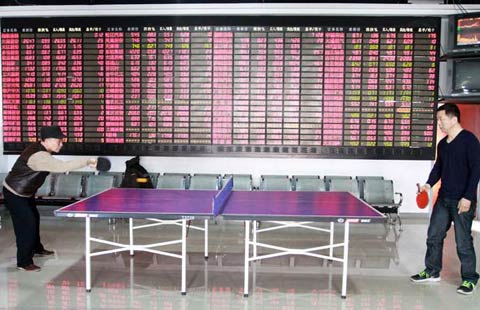
Inexperienced investors pile into frothy market, but many ignore risks as they hope to strike it rich, reports Li Xiang.
Chen Peng, a 25-year-old rookie investor, is a man in a hurry. He has been frantically flipping stocks in the hope of making a fortune amid China's equity market frenzy.
"Everyone has been talking about the hot market," said Chen, who works at a State-owned construction company. One of his friends claimed to have made nearly half a million.
The benchmark Shanghai Composite Index has surged more than 80 percent over the past six months, and it jumped another 2.71 percent on Thursday to a seven-year high of 4,194.82 points. The seemingly unstoppable rally has lured millions of young and inexperienced people like Chen to throw their savings into the market.
But riding the rally is no easy task. Chen said that he has made just a 20 percent gain with all his trading, a return much lower than he anticipated. But he said that in his view, the bull run is far from over.
In Shanghai and Shenzhen, where the two major stock exchanges on the Chinese mainland are located, any hint of a correction is quickly offset by fresh capital inflows.
In March alone, investors opened 4.18 million new trading accounts, followed by another 1.6 million in the first week of April.
Daily trading value has repeatedly exceeded 1 trillion yuan, according to data from the China Securities Depository and Clearing Corp Ltd.
The valuation of stocks listed on the country's startup board has reached nearly 100 times earnings, similar to that of the Nasdaq market before the dotcom crash of 2000.
The Chinese equity market's momentum appears to be defying the conventional wisdom of investment experts, which is that it is usually time to sell when average retail investors enter the market.
Tim Craighead, research head for the Asia-Pacific region at Bloomberg LP, said that momentum-chasing retail investors were among the catalysts for past spikes in China's stock market.
"The track record of the Chinese stock market may reflect the large base of retail investors who aggressively pursue short-term trends as well as a lack of core institutional asset managers," he wrote in a research note. A sustained shift in asset allocation may occur if investment funds flow into these new accounts from trust products and real estate, he added.
Many market observers said that the recent rally has been liquidity-driven as people switch capital from the property market, bonds, trusts and other wealth management products.
Li Jixiang, a 65-year-old retiree in Beijing, said he planned to redeem his mutual fund products, which promised an 8 percent annual return, and put the cash into stocks.
"Eight percent is too little if you compare it with the recent rise in the stock market. I am waiting for a market correction to happen," he said.
But more seasoned investors, such as those who experienced the rollercoaster ride of the A-share market in 2007, when the index reached an all-time high of more than 6,100 points only to plunge to 1,665 points a year later as the global financial crisis erupted, worry that speculation is creating a bubble.
"Many new investors have never seen such dramatic ups and downs in the market and they don't have a sense of how big the risks can be and how much they can lose," said Shi Xianwei, a veteran investor in Beijing. "I am feeling increasingly uncomfortable as many technical indicators point to huge selling pressure," he said.
High valuations in the stock market have also prompted regulators to warn new investors about the potential risks.
Xiao Gang, chairman of the China Securities Regulatory Commission, on Thursday urged such inexperienced investors to adopt a "rational and prudent attitude".
What has puzzled many cooler heads is that the rally is taking place as the economy slows. GDP growth fell to a six-year low of 7 percent in the first quarter, the government said on Wednesday.
Some analysts said that China's equity market has little correlation with economic fundamentals. Instead, it reflects investors' views of government policies and reforms.
"How long the current bull run will last depends on whether the policymakers are serious about reform and whether it is effective," said Ren Zeping, an analyst at Guotai Junan Securities Co Ltd.
He added that 5,000 points "could be the level where the bubble bursts if the economy remains flat. But if the economy successfully rebounds, there's no telling how high the market can go".

Copyright 1995 - . All rights reserved. The content (including but not limited to text, photo, multimedia information, etc) published in this site belongs to China Daily Information Co (CDIC). Without written authorization from CDIC, such content shall not be republished or used in any form. Note: Browsers with 1024*768 or higher resolution are suggested for this site.
License for publishing multimedia online 0108263 Registration Number: 130349