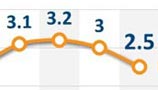
At last week's China Development Forum, there was a consensus among international business leaders that a Chinese economy in its "new normal" of slower but more sustainable growth, driven by innovation and higher value-added activity, would be crucial in maintaining a healthy global economy.
There was also widespread acknowledgment that a successful transition to the "new normal", a term coined by President Xi Jinping to denote the transition, would require an unprecedented effort and, as Premier Li Keqiang has warned, would be painful.
There are no illusions about the task at hand.
Andrew Liveris, chairman and chief executive officer of Dow Chemical Co, told China Daily that never has such an ambitious transition been attempted, not even the nation's transition to a manufacturing economy 30 years ago.
"China needs to change the way it invests in infrastructure so that it is not just spending for spending's sake but spending for the value of a sustainable life in China," he said.
However, for Liveris, regulatory certainty - and the sooner, the better - is a prerequisite for a successful transition.
For example in sustainable urbanization, regulatory standards differ around the world, and companies such as Dow customize their technology to match a market's standards. Without clear standards in China, it cannot effectively bring its products to market that will contribute to the nation's sustainability.
The government is aiming for a 60 percent urbanization rate by 2020, which will mean more than 100 million people moving to cities in the next five years. Raising urbanization standards is just one of the many pressing concerns.
Companies in the private sector, including international ones, can make significant contributions with their experience in sustainable technologies and global regulatory standards.
"The government sets the tone and makes the regulations, but it can't do it in isolation. It has to have the input of society and business," said Liveris. "The scale and importance of China's transition requires a full reform agenda that intersects government, society and businesses."
Although the regulatory environment in China has been an irritant for multinationals for some time, the issue is not just to get more favorable regulations and market access.
"The foreign community simply does not want to be left on the sidelines. It wants to be part of the collaboration that gets to the better regulatory certainty (in China)," said Liveris.
China does allow participation in its law-drafting process, such as opening drafts up for comment as it did with the Foreign Investment Law earlier this year, but there is room for more public-private exchanges.
A case in point is the US-China CEO Council of Sustainable Urbanization.
Consisting of domestic and foreign CEOs, the council has called for effective policies and actions on sustainability standards that the nation needs to develop in an environmentally friendly way.
Similar public-private partnerships can be set up to address innovation, food safety and sustainable agriculture, and to act as points of reference for the government as it steers the economic transition.

Copyright 1995 - . All rights reserved. The content (including but not limited to text, photo, multimedia information, etc) published in this site belongs to China Daily Information Co (CDIC). Without written authorization from CDIC, such content shall not be republished or used in any form. Note: Browsers with 1024*768 or higher resolution are suggested for this site.
License for publishing multimedia online 0108263 Registration Number: 130349