 |
|
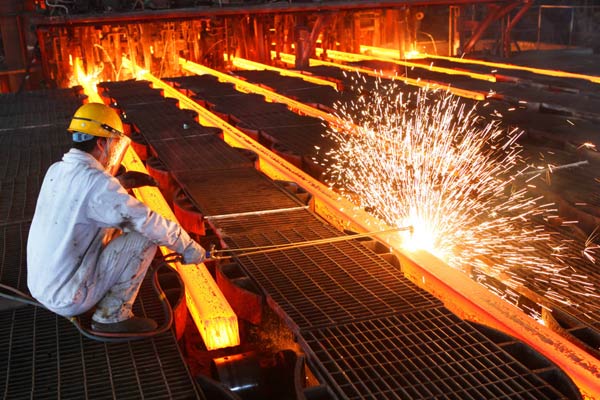
A worker cuts steel bars on the production line of a mill in Lianyungang, Jiangsu province. Si Wei / For China Daily |
China's slowing economy will be at the forefront as?the National People's Congress convenes for its annual meeting this week, with a weekend interest rate cut a reminder of the challenge of balancing restructuring with combating the onset of deflation.
Senior leaders at the National People's Congress, which opens on Thursday, will send an unambiguous signal about the extent of the slowdown when they cut this year's GDP growth target to around 7 percent, which would be the lowest growth in a quarter of a century.
"The focus will be on State-owned enterprise reforms, price reforms and fiscal reforms," said Wang Jun, a senior economist at the China Center for International Economic Exchanges, a well-connected think-tank in Beijing.
"The economic growth target will definitely be lowered. A target of 7 percent is more appropriate."
Officials are expected to argue that a lower growth target provides the opportunity to overhaul State firms, laws and the fiscal system.
They hope to transform the world's second-largest economy away from the export- and investment-led model that powered three decades of rapid expansion into one that is driven by more sustainable domestic consumption.
But with fears of deflation rising - annual consumer inflation plumbed a five-year low of 0.8 percent in January - there is also a need to step in to support the economy, evidenced by two interest rates cuts since late November.
Monetary stimulus
The latest cuts to benchmark lending and deposit rates, announced by the People's Bank of China (PBOC) on Saturday, pre-empted official data showing a second consecutive month of shrinking manufacturing activity.
A rate cut makes debt servicing more manageable, a big issue in China where debt surged amid the stimulus spree launched in the wake of the global financial crisis, and freeing up cash may help ward off deflation.
But it does not necessarily advance the reform process.
The biggest beneficiaries of lower borrowing costs would be big State-run firms such as Air China. The national flag carrier has a debt-to-asset ratio of 72 percent, its 2013 annual report showed.
In the long run however, State companies like Air China are still plagued by deeper problems such as inflexible hiring and firing rules for employees, and a lack of currency hedging expertise that exposes airlines to foreign exchange risks.
Fiscal reform
One of the biggest challenges is getting local governments to implement reforms. Bad debt levels have climbed as the economy has stuttered, heaping pressure on local governments and State-owned companies and prompting some to push back on more stressful changes.
The proposed changes to the fiscal system would force local governments to deal with a funding gap worth 4.2 percent of China's $10 trillion economy, economists at ANZ Bank said.
"If it is not properly managed, the funding gap will drag on the growth in government investment and lead to lower-than-expected GDP growth," they said.
Reforms to stop unauthorized borrowing by local governments, which owe more than $3 trillion, would hurt budgets already squeezed by falling tax receipts and land sales even as they are still expected to spend to support the economy.
Even a plan to let local governments raise funds by selling bonds - a milestone adopted in January - may not win their full support as they would need to disclose their accounts.
To clean up state finances, a new budget law prohibits local governments from guaranteeing any debt incurred by firms, or local government financing vehicles, which were created to borrow billions of yuan from banks on governments' behalf.
"The fiscal reform will be very difficult this year," said an influential economist who advises the government on policy and reform issues.
"If they report more debt, they may be blamed for incurring the debt. If they report less debt, they may get a fewer quotas for municipal bond issuance."

Copyright 1995 - . All rights reserved. The content (including but not limited to text, photo, multimedia information, etc) published in this site belongs to China Daily Information Co (CDIC). Without written authorization from CDIC, such content shall not be republished or used in any form. Note: Browsers with 1024*768 or higher resolution are suggested for this site.
License for publishing multimedia online 0108263 Registration Number: 130349