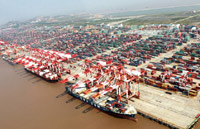
How the world sees or understands China depends partly on the quality, rather accuracy, of the translation of complicated Chinese terms and sentences into foreign languages. The latest examples of such terms are President Xi Jinping's initiatives of the Silk Road Economic Belt and 21st Century Maritime Silk Road to connect Asia and Europe and beyond. The president's two initiatives have come to be known as the "The Belt and Road Initiatives" (literally yi dai yi lu in Chinese).
Xi proposed the setting up of the Silk Road Economic Belt shortly after the G20 summit in St Petersburg, Russia, in 2013, offering the world a way out of the mess caused by the global financial crisis and showing that China is ready to shoulder greater international responsibilities. And Xi's proposal to develop a 21st Century Maritime Silk Road reflects the Chinese leadership's pro-active and strategic thinking to resolve global economic issues.
But it will be almost impossible to express such subtle and delicate thoughts in a language other than Chinese. Even former Australian prime minister Kevin Rudd says China would meet "communications challenge" while explaining its strategic proposals to the world. Rudd, however, says China's concept is very clear; it wants to expand connectivity, which is an extension of ASEAN's idea.
Supporting the setting up of a modern "Silk Road fund" to facilitate investment in infrastructure construction, Rudd says the challenge China faces is not about the content of the proposal but how to properly communicate it. If you translate yi dai yi lu into "normal" English, it won't make much economic sense. Only when you use "belt" in English in the economic sense will people realize that you are talking about connectivity (and not about keeping your pants on). Perhaps the initiatives should be called the "pan-Asian connectivity agenda", says Rudd.
But since Europeans, especially those in Western Europe, are not likely to appreciate the idea of pan-Asian connectivity despite desperately needing a way out of their economic quagmire, Rudd's suggestion might not elicit the expected response.
And even though Justin Yifu Lin, former World Bank chief economist and professor at Peking University, believes the term "The Belt and Road Initiatives" will be ultimately accepted and understood by the West, there remain doubts because it is a word-by-word translation of a pregnant Chinese expression. By ascribing the term a specific meaning in English, we are actually shearing it off of a beautiful and peaceful idea.
So, while giving the combined proposals a specific term in English, we should not translate them literally. For example, they can be called the "Modern Silk Road" proposals.
Better still, if we want to highlight connectivity and infrastructure construction, we can call them the "Asia-Africa-Europe Infrastructure Plan", because given Xi's thrust on reforming governance, establishing the rule of law, fighting corruption and using diplomacy for the common good of the international community, the Silk Road proposals have huge economic and peaceful connotations in terms of connecting the three continents through railways, roads, maritime routes and the Internet.
The author is China Daily chief correspondent in Brussels.

Copyright 1995 - . All rights reserved. The content (including but not limited to text, photo, multimedia information, etc) published in this site belongs to China Daily Information Co (CDIC). Without written authorization from CDIC, such content shall not be republished or used in any form. Note: Browsers with 1024*768 or higher resolution are suggested for this site.
License for publishing multimedia online 0108263 Registration Number: 130349