 |
|
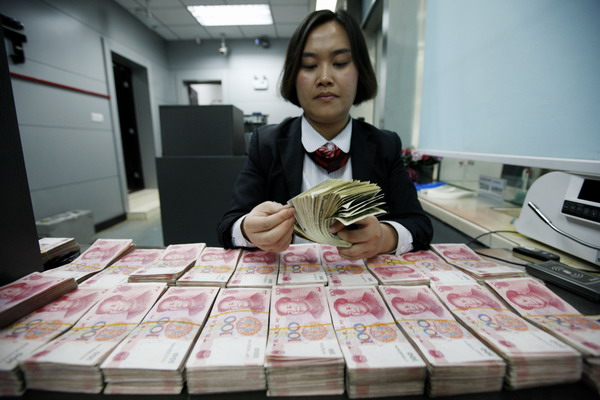
A bank employee counts cash at an outlet of Industrial and Commercial Bank of China in Huaibei, Anhui province. Difficulties are increasing for the central bank to manage liquidity. [Photo/China Daily] |
The nation is paying a price for economic structural adjustment, reflected in commercial banks' surging nonperforming loans. To avert further risks, the People's Bank of China may take measures to control the expansion of debt.
Difficulties are increasing for the central bank to manage liquidity. The traditional measure of increasing money supply based on the position for foreign exchange purchases is no longer efficient, and the uncertainty of capital flows is increasing.
Amid slower economic growth, a rise of commercial banks' NPLs will lead to liquidity problems, which will cause volatility and influence interbank interest rates.
However, it is unlikely that we will see a systemic liquidity crisis, although there may be a short-term liquidity squeeze.
Macroeconomic policies have different target periods.
For the short term, they focus on maintaining moderate liquidity. In the medium term, the policy emphasis will be on fiscal and financial reform. And in the long term, the target will be to reshape the sustainable growth model.
The policies should avoid aggressive stimulus, accelerate the deleveraging process and drive structural reforms.
Monetary policy fine-tuning is likely according to changes in the economic situation, with a preference for maintaining reasonable market liquidity and providing a neutral financial environment for industrial upgrading.
The reforms of the exchange rate and interest rate systems will continue and encourage fair competition in the financial markets.
China's economic growth rate may remain stable at a relatively lower level in 2015, between 6.9 and 7.1 percent, restricted by sluggish demand.
Fixed-asset investment is likely to slow further, restrained by the gloomy real estate market and a moderation in local governments' drive to invest. Consumption growth will become more stable.
Upside risks will mainly come from the growth in external demand, but a trade surplus will result because of a decline in imports rather than growth in exports.
The biggest medium-term uncertainty for the economy is deflation risk.
The Consumer Price Index may remain low under the pressure of a weakening economy. It is difficult to anticipate any rise in the Producer Price Index, as the structural rebalancing process has progressed slowly and overcapacity is still a serious issue for manufacturers.
As global commodity prices may remain low, imported deflation may deepen in 2015.
Cross-border capital flows will become more complicated as the European and Japanese central banks pursue monetary policies that run in opposition to those of the United States, and the dollar is expected to further appreciate.
The author is head of the research bureau of the People's Bank of China, the central bank. The views do not necessarily reflect those of China Daily.

Copyright 1995 - . All rights reserved. The content (including but not limited to text, photo, multimedia information, etc) published in this site belongs to China Daily Information Co (CDIC). Without written authorization from CDIC, such content shall not be republished or used in any form. Note: Browsers with 1024*768 or higher resolution are suggested for this site.
License for publishing multimedia online 0108263 Registration Number: 130349