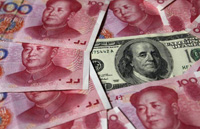
Prior to the recent depreciation, the Chinese currency had consistently risen against the dollar since China started a major foreign exchange reform on July 21, 2005 by scrapping a peg against the dollar. Since then, the yuan has climbed more than 32 percent against the dollar.
However, the Chinese currency has seen regular two-way movements since February after hitting a historical high of 6.04 in mid-January last year. The central parity of the yuan fell 0.36 percent against the dollar in 2014.
Views on the yuan's decline
"It is not surprising to see the yuan fall against the dollar given the currency's cumulative appreciation over the past eight years," said Yu Xuejun, an official at the China Banking Regulatory Commission.
"If the yuan stays firm as it has in past years, it will bring more harm than benefits to the Chinese economy because exports will be less competitive, which will further hamper employment and economic recovery," Yu said.
Analysts caution that while the yuan has recently fallen against the dollar, it has essentially appreciated against other currencies such as the euro and Japanese yen as their depreciation against the dollar has been much steeper.
Yao Jingyuan, former chief economist of the National Bureau of Statistics, predicted that the yuan's exchange rate would be generally stable this year rather than undergoing drastic ups and downs.
Wang Bin said that as the central bank gradually eases foreign exchange interventions, the yuan's exchange rate will be influenced more strongly by market factors and reach an equilibrium.
Analysts also said that China's efforts to promote the yuan's globalization mean authorities will maintain the currency's stability.
Under China's exchange rate reforms, including allowing greater volatility for the yuan by raising floatation bands and conducting currency swaps with other central banks, the yuan became one of the five most widely used currencies in global payments in December behind the dollar, the euro, the British pound and Japanese yen, a report revealed on Wednesday.
Deputy governor of China's central bank Pan Gongsheng said last Friday that China will continue to improve the renminbi exchange rate mechanism this year in line with the central leadership's financial reform drive.
"We will continue to allow the yuan's greater volatility this year by allowing the market to play a more decisive role," Pan said.
Economists also warn of the impact on industries amid the yuan's volatility, with exporters likely to benefit. Meanwhile, airline companies, which have heavy dollar debts, and the real estate market with its exposure to speculative capital investment are likely to suffer the brunt of the yuan's fall and divestment.

Copyright 1995 - . All rights reserved. The content (including but not limited to text, photo, multimedia information, etc) published in this site belongs to China Daily Information Co (CDIC). Without written authorization from CDIC, such content shall not be republished or used in any form. Note: Browsers with 1024*768 or higher resolution are suggested for this site.
License for publishing multimedia online 0108263 Registration Number: 130349