Tea producers in Fujian province reckon they have a brew worth selling to the world, report Hu Haiyan, Hu Meidong and Sun Li in Fuzhou.
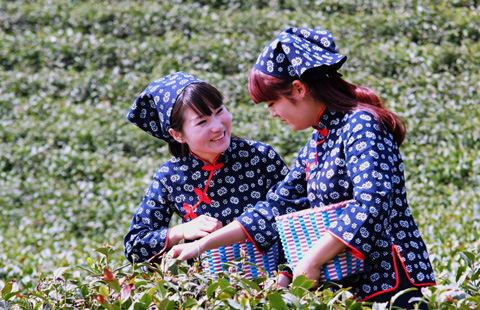
If the sweet aroma of jasmine tea was savored in every corner of the planet, nobody would be happier than the residents of Fuzhou.
For Fuzhou, capital of Fujian province, is where jasmine tea was born, and any cup of it from the city is said to be infused with the breath of spring, said Zheng Jiangmin, director of Fuzhou Agriculture Bureau.
"The city benefits greatly as a result of its jasmine tea exports, which give it great brand recognition across the country and worldwide because of its quality."
The art of scenting tea with jasmine was invented by Fuzhou locals more than 1,000 years ago, and since the Ming Dynasty (1368-1644) in particular it has undergone extensive refinement, he said.
So it is perhaps surprising that it was only 30 years ago that Fuzhou adopted the jasmine as its official flower. In those days the city's population was about 600,000, and about 60,000 were engaged in the jasmine tea industry. That number has halved, reflecting a general decline in agriculture, and the industry is now looking for the kind of refreshment the tea delivers to revive it.
At its peak, about 11,300 hectares of land were under jasmine tea cultivation, but that later fell to 6,666 ha. Fuzhou now has 1,000 ha devoted to growing jasmine flowers and 9,333 ha for jasmine tea.
The city produced 11,000 metric tons of jasmine last year, on a par with production the previous year. Sales revenue was 2.02 billion yuan ($326 million), up 12 percent from the previous year.
Production is expected to remain flat, Zheng said, but prices will rise because of increasing labor costs and higher quality.
Despite the undoubted prowess and reputation that Fuzhou's jasmine tea enjoys, most of the top-grade tea is sold domestically. Much of the export tea is of a lower quality and will end up being served in Chinese restaurants.
The city produces about one-quarter of the country's jasmine tea, of which only 9 percent is exported, said Zhang Jiansheng, deputy director of the economic development division of Fuzhou Agriculture Bureau.
Zhang, who prefers to prepare his brew gong fu cha (a tea ceremony) style, said that exporting jasmine tea is difficult.
"Foreigners need a deeper insight into drinking the tea. It is high quality and closely related to Chinese culture."
Ye Weihong, vice-president of the sales department of Fujian Jiufeng Agriculture Development, said: "Generally, tea is much less popular than coffee worldwide. More often than not, Chinese jasmine tea is found overseas in Chinese restaurants."
Last year the company had sales revenue of about 80 million yuan, and it is expected that the figure will increase 20 percent this year, Ye said.
"We don't export anything at the moment, but we certainly plan to export high-end jasmine tea in the near future."
To tap the overseas market, the group has come up with new categories of tea, such as jasmine black.
"Black tea is much more popular than green tea worldwide, and it needs less time to produce, which makes it a good proposition for us," Ye said.
Jasmine black went on the market in 2010 after two years were spent developing it, and Fujian Jiufeng Agriculture Development became the first company to produce it, Ye said.
"In this we have black tea and jasmine, two elements of the East and the West in perfect harmony."

Copyright 1995 - . All rights reserved. The content (including but not limited to text, photo, multimedia information, etc) published in this site belongs to China Daily Information Co (CDIC). Without written authorization from CDIC, such content shall not be republished or used in any form. Note: Browsers with 1024*768 or higher resolution are suggested for this site.
License for publishing multimedia online 0108263 Registration Number: 130349