 |
|
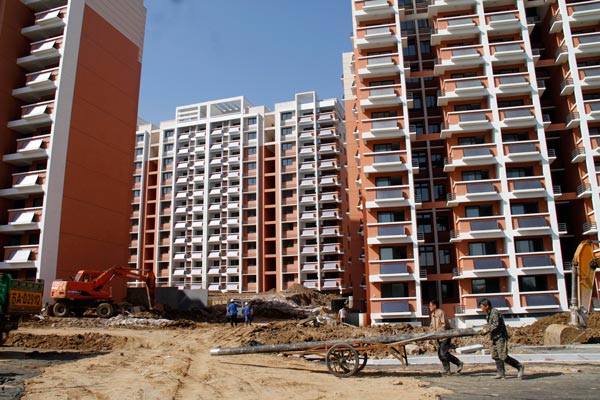
A property construction site in Nanjing, capital of Jiangsu province. Wang Jianlin, China's second-richest man and president of the Wanda Group, claimed the real estate industry had entered a state of "new normal", saying the industry would neither boom nor bust in the next year. DONG JINLIN/FOR CHINA DAILY |
BEIJING - China's real estate industry will focus on selling its mounting inventory amid price corrections and possible collapses of small property developers in the coming year, industry insiders said.
Wang Jianlin, China's second-richest man and president of the Wanda Group, claimed the real estate industry had entered a state of "new normal", saying the industry would neither boom nor bust in the next year.
In the January-November period this year, China's home sale value dropped by 7.8 percent year on year, a huge contrast from the 26.3 percent surge registered in 2013 and the 10 percent increase in 2012, according to the National Bureau of Statistics.
New housing projects also declined nine percent in the January-November period from a year earlier.
"Overall, the industry is in
Wang, however, also dismissed concerns over a house market crash, saying moderate leverage levels, strong government leadership and urbanization potential would prevent China from such a bust. "Stop imagining that China's property market will collapse. There is no possibility for that," Wang said. Chinese regulators have removed home purchase restrictions, cut the benchmark borrowing rates by 0.5 percent and asked banks to offer discount rates to home buyers. In November, home sales reached the monthly high of this year, registering 809.6 billion yuan ($130.9 billion), 93.8 billion yuan more than October. The Central Economic Work Conference last week, a meeting which sets the tone for next year's policies, called for prudent monetary policy to strike a balance between being tight and loose, a signal some analysts interpreted as more macro easing and beneficial to the house market. "The biggest pressure comes from the current inventory," said Ren Zhiqiang, a well-known property developer. Real estate companies may be pressured by cash shortage and debt burdens if the market remains at a low level, he added. In its latest report, UBS maintains that the property sector downturn would pose the largest risk to China's growth. "While we do expect easing in property and lending policies to help stabilizing sales, construction will likely decelerate further as developers digest inventory and slow down their capital expenditures," the UBS report said. Xia Haijun, President of Evergrande Group, believes Chinese property developers will see more sales next year while the home price keeps stable. Xia said property developers would focus on selling inventory in 2015. UBS forecast new property development would drop by 10 to 15 percent in the next year. Real estate investment growth softened to 11.9 percent year-on-year in the January-November period from the 19.8 percent increase in 2013. "We believe this is good for inventory destocking and market health, especially for some oversupplied cities. We expect this trend to continue in December and next year," Nomura said in a note.

Copyright 1995 - . All rights reserved. The content (including but not limited to text, photo, multimedia information, etc) published in this site belongs to China Daily Information Co (CDIC). Without written authorization from CDIC, such content shall not be republished or used in any form. Note: Browsers with 1024*768 or higher resolution are suggested for this site.
License for publishing multimedia online 0108263 Registration Number: 130349