 |
|
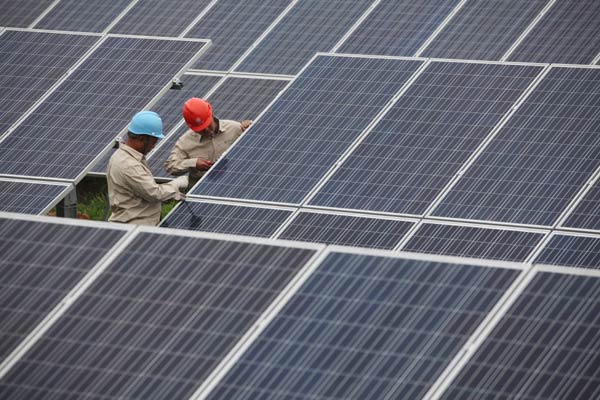
Workers check solar panels in Lianyungang, Jiangsu province. SI WEI/CHINA DAILY |
The Obama administration is considering an expansion of duties on Chinese solar products that has triggered complaints from a South Korean parts supplier that says it would be hurt.
The plan calls for the United States Commerce Department to impose tariffs on all solar panels assembled in China, regardless of the source of their component cells. Currently, $1.5 billion worth of panels with cells made in China are subject to a duty, and many companies shifted production of the cells to other nations in response.
The proposal highlights the challenge of applying US trade penalties on products in a far-flung, global supply chain.
"It is bizarre, and we think it is unprecedented," said Carolyn Byun, US head of legal for Hanwha Solar, a South Korean company with factories in Malaysia and China. "This really has no justification. We need to know ahead of time how things are going to play out."
SolarWorld AG, a Bonn-based company with a plant in Hillsboro, Oregon, got the US Commerce Department in 2012 to apply tariffs on imports of solar cells from the Chinese mainland. After the tariffs kicked in, imports of panels with cells made in Taiwan boomed, and SolarWorld said in a complaint a year ago that Chinese mainland makers had shifted production to skirt the US tariffs.
Earlier this year, President Barack Obama's Commerce Department issued a preliminary decision that proposed expanding the tariffs to imports of cells from Taiwan. A final decision is due by Dec 16.
Companies such as Hanwha and Suniva Inc, a Norcross, Georgia-based solar-cell maker, had avoided taking a position on the US tariffs, while tracking the cases closely.
Hanwha ended its neutrality when the Commerce Department issued a memorandum on Oct 3 saying all solar panels assembled in China would face US tariffs, no matter the source of the cells. The change is necessary to prevent another manufacturing center from becoming a base of production, supplying cells for the low-cost solar panels assembled in China and shipped to the US, according to lawyers for SolarWorld.
"We did not make a specific filing asking for it, but we strongly supported this," Tim Brightbill, a Washington lawyer for the company, said. It will ensure these duties on the Chinese mainland and Taiwan "are enforceable", he said in an e-mail.
The change would target Hanwha, which makes cells in Malaysia that are assembled into solar panels in China and shipped to its distribution and installation business in the US.
Hanwha Solar Holdings Co, based in Seoul, said on Tuesday it will merge its US-listed photovoltaic maker Hanwha SolarOne Co, which has plants in China, with Thalheim, Germany-based Hanwha Q Cells, which it acquired in 2012 and has plants in Germany and Malaysia. The combined operations will be the world's largest maker of solar power cells. Hanwha Solar owns Q Cells and holds 45.7 percent of Hanwha SolarOne.
The company will use a Q Cells factory in Malaysia to avoid US and European import duties. "The anti-dumping issue creates significant opportunities for a geographically diverse company," said D.K. Kim, SolarOne's chief commercial officer.
Under the US proposal, Hanwha's Malaysian-made cells may face a 43 percent tariff, more than many cells made in China, Byun said. The company has started a last-minute effort to get the decision reversed, she said.

Copyright 1995 - . All rights reserved. The content (including but not limited to text, photo, multimedia information, etc) published in this site belongs to China Daily Information Co (CDIC). Without written authorization from CDIC, such content shall not be republished or used in any form. Note: Browsers with 1024*768 or higher resolution are suggested for this site.
License for publishing multimedia online 0108263 Registration Number: 130349