 |
|
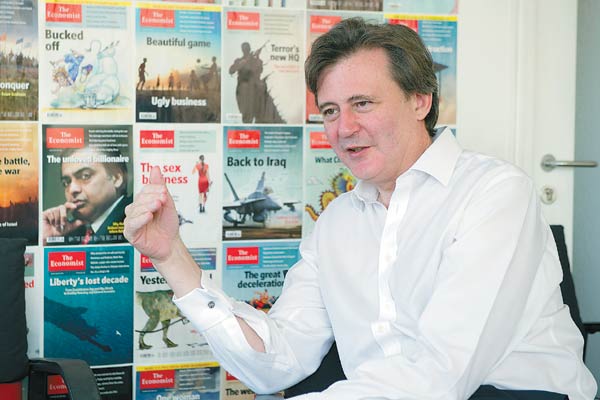
John Micklethwait says on speaking tours around the world, people have focused most on the China aspects of his book. NICK J.B. MOORE/CHINA DAILY |
John Micklethwait believes there are advantages to being an outsider looking in on China.
The editor-in-chief of The Economist says it can provide the necessary detachment. "It is a mixture. To some extent (as a Western publication) you are an outsider and that is part of your value," he says.
"I would not, however, want to add up the number of years the people we have covering China have actually lived and worked there, but I guess it would be at least 50 years so we are certainly very much informed outsiders."
Micklethwait, who is only the 16th editor since the magazine (although still known internally as "a newspaper") was founded in 1843, was speaking in his St James' office in London, shortly before attending his publication's 5th annual China Summit in Beijing on Nov 6.
China has recently dominated the magazine's coverage with one issue carrying a major essay on the world's second-largest economy.
"China as a country is at least as important to us as the United States and you wouldn't find it odd if we did four American covers in a matter of months.
"I would argue that some of them have been driven by the news but I think generally, if you are looking at the Chinese economy at the moment, it is very interesting."
Micklethwait, 52, has been partly diverted this year by handling publicity for The Fourth Revolution: the Global Race to Reinvent the State, for which he has given interviews to Charlie Rose on the US' PBS network among others.
It is the sixth book he has co-authored with Economist colleague Adrian Wooldridge and is widely regarded as one of the most important political books of the year.
It attempts to answer the question as to what system of government is best for modern realities of aging populations and escalating health costs. It contrasts Western liberal democracy with Asian alternatives such as the Singapore model of Lee Kuan Yew, the founding father of the city state.
The book, in fact, opens with a look at the China Executive Leadership Academy in Pudong district in Shanghai, which is attended by many of Chinese government high flyers.
"Many of the things that governments have to do such as delivering healthcare and education are fundamentally not political questions. They are pragmatic.
"That government can be done better is what is interesting now and for this there are ideas from Asia that are worth looking at and also from places like Estonia, Chile and from different parts of Scandinavia. In the arc of geopolitics Asia is certainly competing again."
The "fourth revolution" is essentially the revolution needed to deliver government more efficiently and less expensively. The first three revolutions were the establishment of the nation state in the 17th century; the rise of John Stuart Mill liberalism in Victorian Britain and then the building of the welfare state in the last century.
There was a half revolution in the 1980s with the rise of Milton Friedman-esque free market economics but this ultimately failed to stop the rise of big government with state spending recently rising again as a proportion of GDP in many countries.
Micklethwait, whose office has something of a 1970s feel rather than that of one of few publications to prosper in the Internet age, says there are examples around the world of delivering government better.
In the book he cites Indian hospital entrepreneur Devi Shetty who can deliver open-heart surgery at a 50th of the cost of that in the US and eye operations at 100th of that of the National Health Service in the United Kingdom.
"What he is doing is just an example of how things are behind in the West. He has looked at heart surgery and applied Silicon Valley economics."
Micklethwait says these issues present a challenge for China, which is trying to build its own healthcare system, as much as it does to Western governments.
"It is about modernization, pushing government through the same sort of revolutions we have had in the private sector.
"You have only got to look at my industry (media publishing). It has been turned upside down by technology over the past 20 years. Yet very little of the same technology has had an effect on government at all."

Copyright 1995 - . All rights reserved. The content (including but not limited to text, photo, multimedia information, etc) published in this site belongs to China Daily Information Co (CDIC). Without written authorization from CDIC, such content shall not be republished or used in any form. Note: Browsers with 1024*768 or higher resolution are suggested for this site.
License for publishing multimedia online 0108263 Registration Number: 130349