 |
|
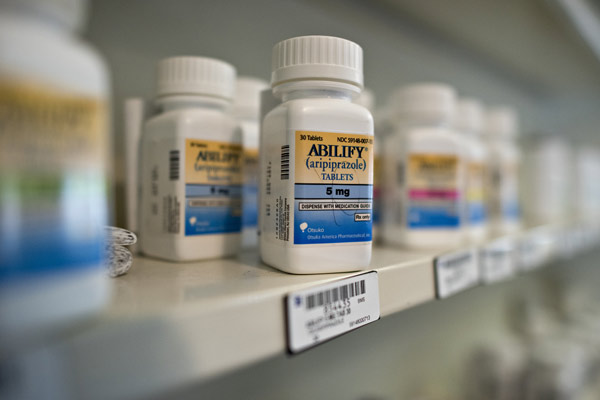
Abilify, a depression drug made by Bristol-Myers Squibb on a pharmacy shelf in Princeton, New Jersey, the United States. The US-based company has reportedly laid off nearly 1,000 people in China, mostly sales representatives.[Photo / Agencies] |
Multinationals shift sales focus as govt tightens measures to check corruption
Pharmaceutical companies, especially multinationals, are looking for new ways to boost sales as China continues to crackdown on corruption.
Following last year's bribery scandal involving British pharmaceutical giant GlaxoSmithKline, multinational pharmaceutical companies in China are watching their conduct in the market. And they know that what they used to do, with sales representatives playing a pivotal role, will no longer be workable in the new market environment.
Chinese media have reported that these companies are cutting sales staff. Among them was United States-based Bristol-Myers Squibb, which reportedly laid off nearly 1,000 people, mostly sales representatives.
The company did not directly address those reports when contacted by China Daily, but it said that was undergoing a transformation.
"As part of our organizational evolution, we are reviewing and determining the appropriate structure and size of the organization with the objective to best serve our patients in China," the company said in an e-mail.
"We will make every effort to keep the impact on individuals to the minimum. It is also our commitment to treat all affected employees fairly and to implement the adjustment in accordance with the applicable laws and regulations of China," it said.
The company said its objective is to create an organization that is more agile and customer-focused, therefore responding faster and better to market needs and benefiting patients.
Many other pharmaceutical companies are also seeking a "transition" to new profit and sales models, a shift from the internal culture driven by sales growth to a new marketing-centric path, industry insiders said.
"What we know is that sales representatives' access to hospitals in general, and physicians specifically, is not going to be as easy and readily available as it has been in the past. So, multinational pharmaceutical companies must find new, innovative ways of accessing these key opinion leaders," said Benjamin Shobert, managing director of the US-based Rubicon Strategy Group.
"It has become harder for sales staff to work with hospitals and doctors. Since last year, the anti-corruption efforts by Chinese authorities have constantly been intensified. Some hospitals also have ordered doctors not to have any contact with medical sales staff. Thus, for companies, changes are inevitable," said an industry source who declined to be identified.
Under the new marketing-centric model, academic communication officers or medical liaison staff will be relied on heavily. Companies' interaction with physicians, patients and government departments will be heavier on science and clinical efficacy issues than in the past, although it is still uncertain what the new marketing-centric model will look like, said Shobert.
GSK was the first pharmaceutical company to publicly implement new management and performance evaluation systems for its sales team in China. In December 2013, the company announced it will no longer reward its Chinese sales representatives based on sales volume.
Under the new system, customer service employees will be evaluated on technical knowledge, quality of service and adherence to the company values of transparency, integrity, respect and patient focus, it said.
"Some of these activities already exist in China, but they will become more important, represent a more significant part of the multinationals' activities and become much more strategic in terms of structure, frequency and how this information is distributed," Shobert said.
According to a report released by consultancy McKinsey & Co in 2012, China's top 10 multinational pharmaceutical companies had a total sales force of more than 25,000 in China, even as they were reducing sales staff in the US and Europe.
Local Chinese media reported that openings for medical sales representatives declined during the latest recruiting season. But demand for medical science liaison staff significantly increased.
Earlier reports said that more than 90 percent of biomedical and pharmaceutical companies in the United States use medical liaison staff. There are about 3,000 medical liaison staff in China, and the number could rise by 20 percent a year.
"As China becomes a more mature and established market, specifically as the government's reimbursement for specific therapies increases, as hospital funding changes, all of this... will mean the market looks more and more like the US and European markets," Shobert said.

Copyright 1995 - . All rights reserved. The content (including but not limited to text, photo, multimedia information, etc) published in this site belongs to China Daily Information Co (CDIC). Without written authorization from CDIC, such content shall not be republished or used in any form. Note: Browsers with 1024*768 or higher resolution are suggested for this site.
License for publishing multimedia online 0108263 Registration Number: 130349