China is expected to launch Hong Kong-Shanghai Stock Connect, a plan that will bring the Hong Kong and Shanghai stock exchanges together and allow mutual investment. With significant doubts hanging over the plan since the outset, the fact that authorities are sticking to a timetable many believed to be unachievable shows that policymakers are serious about reforming the world's second-largest economy.
Under the plan, mainland investors will be allowed to invest up to 250 billion yuan ($41 billion) in 268 Hong Kong stocks, while Hong Kong investors will be able to invest up to 300 billion yuan in 568 domestic equities. Investment into Shanghai from Hong Kong will be capped at 13 billion yuan a day, and investment in the other direction will be capped at 10.5 billion yuan a day. It is the first time that domestic individuals will be allowed to invest overseas.
Many policy priorities are supported by the introduction of Stock Connect. On a macro level, the Chinese government is clearly trying to shift the financing of the economy away from riskier and opaque shadow banking toward the more transparent and regulated capital markets. In the first eight months of the year, bond issuance rose 17.7 percent year-on-year to 1.63 trillion yuan, and equity financing rose 60.2 percent year-on-year to 242 billion yuan, the People's Bank of China says. By contrast, loans from trust companies, a key driver of shadow banking, fell 73.3 percent year-on-year to 393 billion yuan, while banker's acceptance bills, another form of off-balance-sheet financing, fell 59.7 percent year-on-year to 260 billion yuan.
While equity issuance has risen significantly, the fundraising size remains small relative to other sources of financing. China has no lack of companies wanting to engage in IPOs, with as many as 600 companies lining up to list on the domestic exchanges. What has been lacking in recent years has been willing buyers, as share prices have continually fallen since 2009 highs, and turnover has fallen, too. Introducing new foreign capital should help.
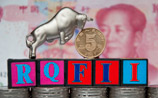
Without Stock Connect, the only way foreigners have been able to invest in the domestic market is through the Qualified Foreign Institutional Investor scheme, which had an approval quota of $59.6 billion by the end of August, or roughly 365 billion yuan. Once the 300 billion yuan Stock Connect quota is fully utilized, total foreign holdings of domestic shares will almost double.
The government is also trying to bring domestic investors back to the market. In the first week of September Xinhua News Agency published at least eight long articles encouraging people to invest in stocks. With the government expecting new inflows from foreign investors potentially driving up share prices, this is a clever strategy to make Chinese households a bit of money.
If markets rise first from domestic inflows and later from foreign inflows, it could lead to even greater domestic inflows and push the Shanghai Stock Exchange even higher, the Shanghai Composite Index being up by more than 14 percent since the end of June. While foreign investors' domestic investment is now capped at 300 billion yuan under the quota, authorities have said that both the list of investible securities and quota could be expanded. A virtuous cycle could be created that would drive a new bull market for Shanghai equities.
Beyond the desire to boost transparent financing, bringing more money into the stock market is also important for other domestic reforms. In particular, it should push forward the reform of State-owned enterprises, which authorities are trying to achieve through the capital markets. One of the main ways the government wants to reform SOEs is by introducing private investors and boosting corporate governance to drive efficiency gains. A number of SOEs will be listed on the capital market, and many SOE subsidiaries will be spun off and listed. Greater domestic liquidity supports this process.
It also benefits mergers and acquisitions in overcapacity sectors such as steel and cement. In many of the old industrial sectors markets will deteriorate as the economy rebalances and becomes less reliant on fixed-asset investment and more reliant on consumption and the provision of services. The government hopes that these sectors can be restructured with M&As through the capital market.

Copyright 1995 - . All rights reserved. The content (including but not limited to text, photo, multimedia information, etc) published in this site belongs to China Daily Information Co (CDIC). Without written authorization from CDIC, such content shall not be republished or used in any form. Note: Browsers with 1024*768 or higher resolution are suggested for this site.
License for publishing multimedia online 0108263 Registration Number: 20100000002731