A massive urban renewal project could stabilize growth and raise living standards, but it poses problems for real estate developers, report Yao Jing and Zheng Yangpeng.
The central government's subsidized housing program, which calls for the construction this year of 7 million affordable apartments nationwide, is posing challenges to a property sector that is already under pressure from sinking home prices.Some analysts have said that getting involved in these projects is away to help developers during difficult times. But it is unclear whether the program can help revitalize the sluggish real estate sector.
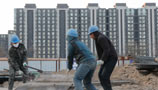
China Development Bank extended 219.5 billion yuan ($35.7 billion) in loans for urban renewal projects during the first half of 2014. That lending is forecast to help 2.13 million low-income families move out of antiquated, slum-like housing and into modern apartments.
 |
 |
"Loans will exceed 400 billion yuan this year, and the bank will do its best to ensure the money is used efficiently," CDB Chairman Hu Huaibang said recently.
In late July, CDB was given regulatory approval to launch a new business unit that will increase funding for urban renewal projects.
"Developers will benefit from participating in renovating rundown areas because they can get loans at low interest," Ren Zhiqiang, chairman of Huayuan Property Co Ltd, told an economic forum in August.
But Ren also expressed concern about the high costs of compensation that are associated with demolishing rundown areas, which may scare away developers.
Yin Zhongli, a researcher at the Institute of Finance and Banking at the Chinese Academy of Social Sciences, said that while the property market remains weak, urban renewal projects are one way for developers to weather the tough times. He warned that the combination of shrinking demand and rising supplies of subsidized housing will further squeeze the market.
Some developers have already decided to avoid subsidized housing projects. An executive with a major developer in Changsha, capital of Hunan province, who declined to be identified, said his company is not interested in renovation projects.
The resettlement of residents is extremely difficult, the executive said, and developers face mounting pressure to recover their costs.
"As a public company, we have stringent requirement for cash flow and annual returns. What we worry the most about is the uncertainty over the time frame of resettlement. Sometimes a few households that refuse compensation can delay the whole project indefinitely," he said.
Eddie Heng, executive director and head of CBRE Consulting China, a commercial real estate consultancy, said although land shortage in first-tier cities has given rise to the demand for land redevelopment, the shortage so far has not yet grown to an extent that left developers with no choice but acquiring land where shantytowns sit.
In order to attract developers, Heng said, there are a few strategies to consider, for example, offering low-interest rate loans to developers, and there are some experiments in which local governments offered residents temporary accommodations and promised that they could return to their original locations when rebuilding was finished, reducing resistance to projects in some cases.
But Heng said that there has not been an "established, replicable and commercially viable" model to attract developers into this field. The attraction could be further undermined by stringent requirement of plot ratios in some cities.
"The interest will only increase if the land is located in prime locations, and developers are allowed to have more flexibility in proposing the development mix of the projects," Heng said.
"To make developers willing to join the projects, the site must be in a prime location and the developer should be allowed to develop some commercial projects to gain higher profits," Heng said.
Although there is an over supply of large apartments inmost cities, there is still a shortage of smaller units for first-time homebuyers in many cities. If homes built from shantytown redevelopment fit this demand, the under supply situation will be alleviated.
Jiang Xueqing contributed to this story.

Copyright 1995 - . All rights reserved. The content (including but not limited to text, photo, multimedia information, etc) published in this site belongs to China Daily Information Co (CDIC). Without written authorization from CDIC, such content shall not be republished or used in any form. Note: Browsers with 1024*768 or higher resolution are suggested for this site.
License for publishing multimedia online 0108263 Registration Number: 20100000002731