A department store near Beijing's Forbidden City offers mammoth ivory products. The State-owned retail chain Chinese Arts & Crafts, which has outlets across the mainland and Hong Kong, announced in mid-March that it had suspended all sales of elephant ivory but would continue selling mammoth ivory.
Most of China's mammoth carving takes place in the Pearl River Delta region but there are also carving factories in Fuzhou on China's east coast, Harbin in Heilongjiang province in the northeast and Chifeng in the Inner Mongolia autonomous region.
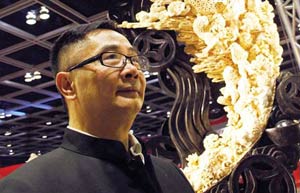
"Mammoth ivory is a very good resource for maintaining traditional ivory carving techniques, but some thing new for most Chinese buyers," says Chen Shu, president of the China Association of Mammoth Ivory Art Research.
The association's 200 member vendors and manufacturers voluntarily created a system of cataloguing mammoth ivory items similar to the government-mandated identification cards for elephant ivory products. The mammoth ivory cards allow buyers to confirm mammoth products' authenticity.
Catalogued items in Chen's showroom range from the tiny (imitation postage stamps carved on a surface less than 1 millimeter thick) to the massive (complete and polished raw mammoth tusks that corkscrew from floor to ceiling).
"The purpose of this organization is to help Chinese society recognize the value of mammoth ivory," says Chen, noting that the raw price of mammoth ivory is much more expensive than that of elephant ivory.
Although mammoth tusks are sometimes found in excellent condition, they are also often broken and damaged due to geological conditions and exposure to the elements. Importers often have to buy bulk shipments that include a mix of good and poor-quality mammoth ivory. Much of the lesser-grade ivory goes to waste, increasing overheads.
"The exact price of mammoth ivory is difficult to tell because of varying quality," Chen says. "In 2010, a colleague told a journalist that the raw price of mammoth ivory is around 20,000 yuan ($3,250) per kilo, but I don't think that's very accurate."
He points to an enormous, polished raw tusk nearby. "For example, if that 50-kilogram piece behind you is priced at 20,000 yuan per kg, the tusk would be priced at 1 million yuan. But in fact the market price could be 2 million because it is a better grade and very rare."
To give an idea of the rise in value of mammoth ivory, Chen explains that raw elephant ivory sold for roughly 1,000-2,000 yuan per kg a decade ago, while raw mammoth tusks sold for hundreds of yuan for the same weight.
After 10 years, Chen estimates raw elephant ivory might sell at 8,000-12,000 yuan per kg, while mammoth ivory's price has increased at a much higher rate. "Now the price of raw mammoth ivory is around 30,000-40,000 yuan per raw kg, and I think the price is still going up," he says.
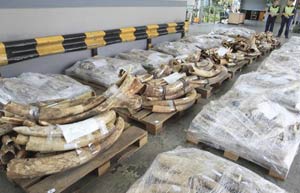
Chen says that Russian mammoth ivory exports to China have gradually declined since 2006 - a peak year with 30-40 tons imported. He suspects the cross-border trade in recent years to have been closer to 20 tons. Many experts estimate that only 10-15 years worth of mammoth ivory remains underground.
 |
 |
| Mammoth task to achieve |
|

Copyright 1995 - . All rights reserved. The content (including but not limited to text, photo, multimedia information, etc) published in this site belongs to China Daily Information Co (CDIC). Without written authorization from CDIC, such content shall not be republished or used in any form. Note: Browsers with 1024*768 or higher resolution are suggested for this site.
License for publishing multimedia online 0108263 Registration Number: 20100000002731