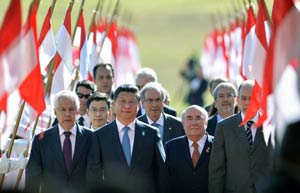
BEIJING - China and Brazil face the task of refocusing their trade with each other onto more sophisticated products and investment as the two major emerging economies modernize their industrial structure and their demand for natural resources slows.
China has been Brazil's largest trade partner since 2009 and Brazil is China's ninth largest trade partner worldwide and the largest in Latin America. However, the growth of bilateral trade is slowing down.
In the first half of this year, export and import of goods between the two countries increased 7 percent year on year, a sharp drop from the 43.6-percent growth in the same period three years ago.
Sun Yanfeng, a researcher with the China Institutes of Contemporary International Relations, attributed the cool-down mainly to the effect of economic restructuring in China.
 |
|
|
Trade between the two countries has long been concentrated on raw materials.
In the first six months of 2014, mineral and plant products accounted for 86.5 percent of Brazil's exports to China.
Although the pace of growth in bilateral trade is expected to continue dropping, Sun sees opportunities for Chinese and Brazilian authorities to place more attention on the added value of their products and exploring new fields of trade.
Take iron ore as an example. "China's demand for raw iron ore will decline with the shrinking of its energy-intensive industries, but it will need more of the processed iron ore products that Brazil can export," said Sun.
China's decreasing demand for natural resources also comes at a time when Brazil is looking to move away from resource-centered industries, noted Zhou Zhiwei, a researcher with the Chinese Academy of Social Sciences.
Meanwhile, economic ties between the two economies could go far beyond simple trade to include more joint ventures and investment, with Brazil craving Chinese funding of building projects. Chinese companies' relative wealth can help compensate for the shortage of funding in Brazil.
Brazil's economic transformation is centered around modernizing its industry and encouraging investment and construction of infrastructure. "These are just the areas where China has accumulated a lot of experience," said Zhou.
Sun stressed that trade alone is not enough to push forward the two countries' economic ties. "What is more important is cooperation in investment, financing and joint contracting, which could become the new engines for the economic ties."
Over the past year, the Brazilian government has announced plans for a slew of infrastructure projects, including the extension of airports and ports, the building of 11,000 km of railway and 7,000 km of highway.
During Chinese President Xi Jinping's visit to Brazil in July, Brazilian President Dilma Rousseff welcomed broader investment in his country by Chinese enterprises, particularly highlighting transportation, infrastructure, agriculture, information, logistics and innovation in science and technology.

Copyright 1995 - . All rights reserved. The content (including but not limited to text, photo, multimedia information, etc) published in this site belongs to China Daily Information Co (CDIC). Without written authorization from CDIC, such content shall not be republished or used in any form. Note: Browsers with 1024*768 or higher resolution are suggested for this site.
License for publishing multimedia online 0108263 Registration Number: 20100000002731