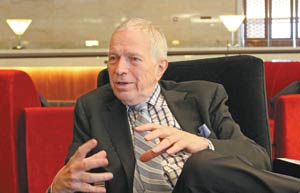
The advantage for the US of the strong demand for the dollar from countries that carry a surplus is that interest rates for dollar securities become low, and it becomes increasingly cheap for the US to finance its debt. "This means US companies can borrow more cheaply than they otherwise could around the world and spread their influence. That's the main economic and financial advantage of the reserve currency," Wheatley says.
He says a more dramatic example of the United States' exercise of its currency power is the financial sanctions it has placed on countries it blacklists from a political perspective.
It has sanctions, for example, against using US dollars to finance trade with Sudan, Iran and Cuba. In early July, the US government fined the French bank PNB Paribas $9 billion for breaking this sanction via money laundering from 2004 to 2012, and as additional punishment has prevented the bank from clearing certain transactions in US dollars for one year from the start of 2015.
And in 2012, London-based Standard Chartered bank paid a total of $674 million to US regulators and authorities for illegally hiding transactions with Iran and other countries under US sanctions. In 2012, British banking giant HSBC also was fined $1.9 billion by US regulators for sanctions violations.
"Because the business trading with these countries which BNP Paribas is helping to finance is denominated in dollars, it had to circulate through the Fed and is subject to US rules. If it had been based on renminbi or even euros, then BNP Paribas and other banks would not have been caught," says Wheatley.
He adds that the US government has been assuming the responsibilities of a country with the dominant global reserve currency in some respects but not all. According to Wheatley, in some areas it has been using its financial power irresponsibly and risks political backlash, as is evident in recent criticism from French Finance Minister Michel Sapin. He was critical of the size of the penalties imposed after BNP Paribas pleaded guilty to criminal conspiracy charges as part of a plea agreement.
Sapin urged eurozone countries to trade more in euros in order to break the monopoly the dollar has on international transactions.
"We (Europeans) are selling to ourselves in dollars, for instance, when we sell planes. Is that necessary? I don't think so. I think a rebalancing is possible and necessary, not just regarding the euro but also for the big currencies of the emerging countries, which account for more and more global trade," Sapin told the Financial Times.
China's push to internationalize its currency started in 2008, when the global financial crisis demonstrated the danger of too much reliance on the dollar. During the G20 summit in November 2008, former Chinese president Hu Jintao called for "a new international financial order that is fair, just, inclusive and orderly".
Beijing soon began to encourage the use of its currency in international trade, swap arrangements among central banks, and bank deposits and bond issuances in Hong Kong.
Trade in offshore renminbi has since boomed. Increasing Chinese exports also led to a surge in demand for renminbi outside China as Chinese exporters increasingly expect to be paid in their own currency to eliminate exchange risks.
Wheatley says it definitely makes more sense for some emerging economies to trade with China in yuan, and China is already moving in this direction, as can be seen by China's support of emerging market financial institutions like the BRICS Development Bank and Asian Infrastructure Bank. "China is saying that it wants to forge regional relationships. It's logical that as Chinese trade continues to grow, the yuan would occupy a larger regional role."
However, the road to making the yuan a popular investment currency and a global reserve currency is still long, particularly because China has yet to liberalize much of the capital account controls on the yuan, Wheatley says.
China already is taking some steps to achieve current controls liberalization. It is allowing offshore yuan to be reinvested into its onshore financial markets through the RQFII (Renminbi Qualified Financial Institutional Investors) plan.
|
 |
 |
| RMB to be third largest international currency by 2020 | RMB will cash in on growth |

Copyright 1995 - . All rights reserved. The content (including but not limited to text, photo, multimedia information, etc) published in this site belongs to China Daily Information Co (CDIC). Without written authorization from CDIC, such content shall not be republished or used in any form. Note: Browsers with 1024*768 or higher resolution are suggested for this site.
License for publishing multimedia online 0108263 Registration Number: 20100000002731