Officials and State media emphasized that "growth" and "reform" were not mutually exclusive, because growth was essential for reform. But economists said that in China, it is the priorities that count.
"Secondary importance" is meaningless, said an anonymous Chinese economist. "Reform is still important, but mostly it's just talk."
That's obvious from the recent announcement of State-owned enterprises that are to experiment with mixed ownership. Although the plan had some bright spots, many experts who had long followed China's SOE reforms could not conceal their disappointment. They noted that the few companies involved were limited to fully competitive sectors. Giants in State-controlled sectors, such as China Petroleum & Chemical Corp and China National Petroleum Corp, were missing from the list.
 |
 |
"But in terms of simplifying administrative procedures and greater access for private investment, the reforms are not well-implemented." Zhu said that fiscal reform, land reform and household registration (hukou) reform are unlikely to speed up in the second half.
Many are also concerned that "rebalancing" is being sidelined, given that the recent stimulus moves still heavily rely on government spending. For example, the budget for railway investment, traditionally a convenient tool for stabilizing growth, has been revised three times this year and now stands at 800 billion yuan ($129.8 billion).
These projects have reinforced the traditional wisdom that government-backed investment is the only way to prop up growth.
Mounting debt, meanwhile, is an increasingly acute problem. Standard Chartered Plc has estimated that the ratio of total debt to GDP climbed from 147 percent at the end of 2008 to 251 percent at the end of June this year.
The United States, a much richer country, has a ratio of 260 percent.
"The investment share of GDP is increasingly supported by credit rather than businesses' retained earnings or the savings of entrepreneurs," Bill Adams, senior international economist for PNC Financial Services Group, was quoted by Reuters as saying.
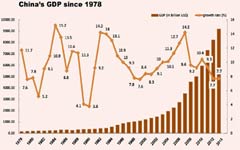
With the hefty increase in government investment, economists wonder if the latest progress in rebalancing can be maintained. In the first half, consumption contributed 54.4 percent to GDP growth, ahead of the 48.5 percent contribution from capital formation.
Meanwhile, the contribution of capital formation to GDP growth declined to 47 percent in 2012, but thanks to heavy investment against a slowdown in 2013, it rebounded to 54.4 percent in that year.

Copyright 1995 - . All rights reserved. The content (including but not limited to text, photo, multimedia information, etc) published in this site belongs to China Daily Information Co (CDIC). Without written authorization from CDIC, such content shall not be republished or used in any form. Note: Browsers with 1024*768 or higher resolution are suggested for this site.
License for publishing multimedia online 0108263 Registration Number: 20100000002731