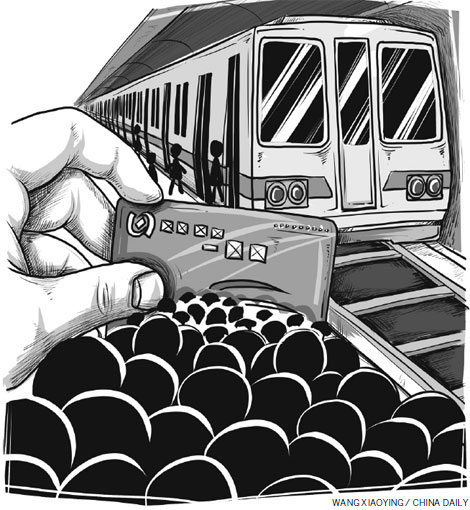
The Beijing municipal commission of development and reform is soliciting public opinion on whether fares for public transportation should be raised. For many Beijing residents, the 18-day (from July 3 to 20) exercise signals the end of the city's "low fare public transport system".
That more than 22,000 people have submitted over 37,000 suggestions in a week reflects the wide public concern over fare hikes and the complex nature of the issue.
|
 |
 |
The city's public transport system has been incurring losses for the past few years and filling its fiscal gap with the subsidies received from the municipal government. The truth is that, without the subsidies it would be impossible to run the transport system. According to Beijing municipal commission of development and reform figures, the operating income of Beijing subway in 2007 was 1.18 billion yuan against an expenditure of 1.34 billion yuan. In 2013, the operating income did increase nearly threefold - to 3.22 billion yuan - but then the expenditure rose more than fivefold - to 6.68 billion yuan.
The losses suffered by Beijing's bus service are even more serious. Its annual income dropped from 3.09 billion yuan in 2007 to 2.59 billion in 2013 while its expenditure jumped from 8.88 billion yuan to 17.62 billion yuan. In 2012 public transport accounted for an estimated 7.9 percent of Beijing's municipal fiscal expenditure in people's livelihood, much higher than that on medical and health services. Ma Boyi, spokesman for the transport administration bureau of Beijing municipal commission of public transport, recently told People's Daily that the losses incurred by the public transport system have become a huge obstacle on the road to sustainable development.

Copyright 1995 - . All rights reserved. The content (including but not limited to text, photo, multimedia information, etc) published in this site belongs to China Daily Information Co (CDIC). Without written authorization from CDIC, such content shall not be republished or used in any form. Note: Browsers with 1024*768 or higher resolution are suggested for this site.
License for publishing multimedia online 0108263 Registration Number: 20100000002731