BEIJING - The value of the Chinese currency renminbi, or the yuan, weakened 55 basis points to 6.1506 against the US dollar in its central parity on Wednesday, ending its sharp three-day rise.
From Friday to Tuesday, the yuan's strength against the US dollar in its central parity increased 257 basis points, the largest three-day move since April 2013, according to an HSBC research note. On Monday alone, the yuan gained 138 basis points to 6.1485 against the US dollar.
The central bank, or the People's Bank of China (PBOC), is sending a strong message to the market that the yuan will behave with greater two-way volatility and the timing for re-injecting volatility is also a nod to tentatively stabilizing economic conditions, as indicated by May exports, according to Wang Ju, senior foreign exchange strategist at HSBC.
 |
|
 |
The yuan depreciated from early January to early June this year, with the central parity of the yuan against the US dollar down 1.12 percent and that in the spot market down 3.55 percent.
Lian Ping, chief economist of the Bank of Communications, said that as trade data picked up in May following weak performances in four months, investors may have different expectations of the Chinese currency and this round of depreciation may have come to an end with two-way fluctuations possible in the future.
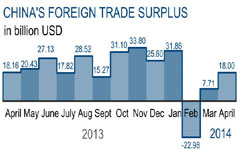
China's exports rose 7 percent year on year to $195.47 billion in May.
Wang said that it is still a little early to expect a significant recovery in the yuan, but the PBOC's recent actions suggest that the sharp sell-off in the yuan, triggered by policies that curb hot money inflows and unwinding of heavy market positioning, has likely come to an end.
China loosened its grip on the yuan-dollar exchange rate in March this year, widening the daily trading band to 2 percent from 1 percent. That is, in China's foreign exchange spot market, the yuan is now allowed to rise or fall by 2 percent from the central parity rate each trading day, rather than the previous limit of 1 percent.
The central parity rate of the yuan against the US dollar is based on a weighted average of prices offered by market makers before the opening of the interbank market each trading day.
Ultimately, the central bank will need to switch to a market-oriented fix, implement a much wider trading ban and introduce broader capital account liberalization, Wang said.

Copyright 1995 - . All rights reserved. The content (including but not limited to text, photo, multimedia information, etc) published in this site belongs to China Daily Information Co (CDIC). Without written authorization from CDIC, such content shall not be republished or used in any form. Note: Browsers with 1024*768 or higher resolution are suggested for this site.
License for publishing multimedia online 0108263 Registration Number: 20100000002731