Turbine maker counting on new ultrahigh-voltage lines to push up market demand
 |
|
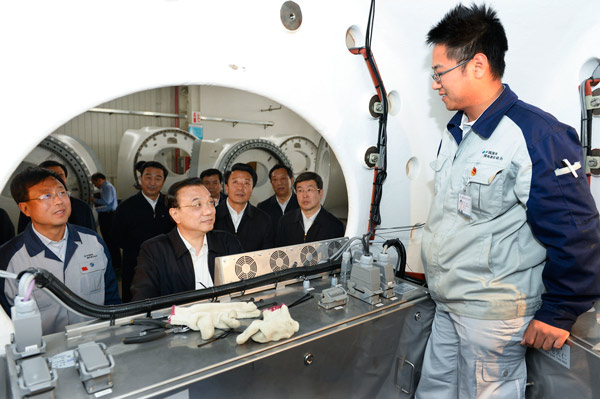
Premier Li Keqiang talks to a worker at a local branch of China Guodian United Power Technology Co during an inspection tour in Chifeng, Inner Mongolia autonomous region, on Friday. Liu Zhen / China News Service |
When Chen Lin said in a firm voice that all wind-generating sets are independently developed by his company, Premier Li Keqiang responded good-naturedly: "I just don't believe it."
The exchange took place during Li's visit to Chifeng, in the Inner Mongolia autonomous region, on Thursday, at a leading supplier of wind-turbines.
Stepping onto a generating set, the premier opened a metal box containing key parts of the two-story-tall giant. Electric devices lined up in rows could be seen at a glance, most of them imported from European countries.
Chen, the general manager of China Guodian United Power Technology Co, looked a little embarrassed, explaining that some large-capacity products still need imported parts.
"Green energy is the future of energy resources. You should not focus only on the local demand, but on a broader global market," Li told workers.
"Innovation is the driver of the green-energy industry, as well as of the Chinese economy at large."
Wind power in the region has reached 1,849 million kilowatts, the most in China, and accounted for one-fourth of the country's total wind-power capacity.
Yet, the considerable capacity in the region is being shadowed by an equally considerable 30 percent in the wind curtailment rate.
"That is because of the relatively weak power transmission lines in central and western China, where wind energy is abundant," Chen said. "Generators are being curtailed since the electricity they generate cannot be connected onto the grid and be transmitted to the east."
Chen said his company has seen a sharp drop in revenues since 2011.
The sale of generators crashed from 600 sets in 2011 to 183 sets last year because of shrinking market demand. Not only his own business but most of the businesses related to wind power in China have been influenced by the lack of transmission capability, Chen said. "The fever for wind power has gone."
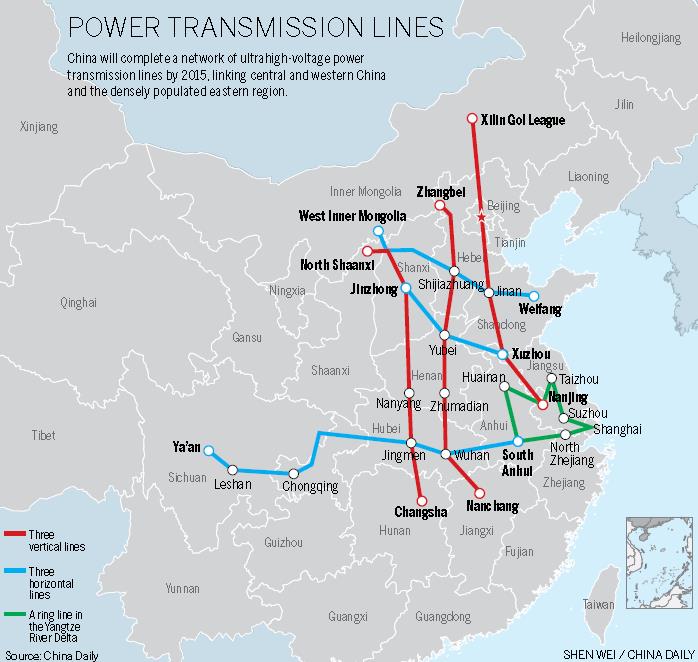
Chen is counting on the construction of ultrahigh-voltage power transmission lines for recovery. The State Energy Commission decided in April to construct more such lines this year.
After completion, the technology - which refers to 1,000 kV (1 million volts) AC and 800 kV DC transmission - can move a large amount of power from coal production and hydropower centers in inland areas to the densely populated eastern zones.
With a total investment of more than 210 billion yuan ($34 billion), the proposed 12 power transmission lines include four ultrahigh-voltage alternating current (UHV AC) lines, five UHV direct current lines and three conventional networks.
"I believe UHV transmission lines is a way to solve the current difficulties," he said, "but it is hard to say how much time it will take for the situation to improve."

Copyright 1995 - . All rights reserved. The content (including but not limited to text, photo, multimedia information, etc) published in this site belongs to China Daily Information Co (CDIC). Without written authorization from CDIC, such content shall not be republished or used in any form. Note: Browsers with 1024*768 or higher resolution are suggested for this site.
License for publishing multimedia online 0108263 Registration Number: 20100000002731