 |
|
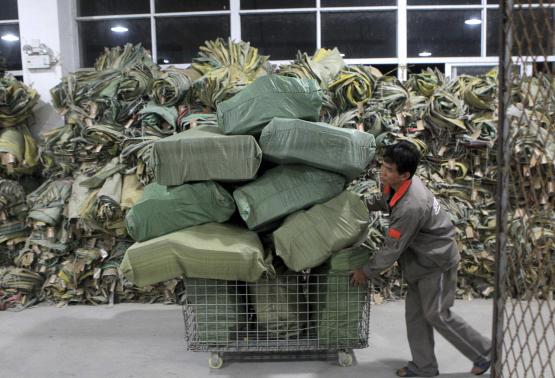
A worker pushes a cart filled with packages at a logistics hub in Fuzhou, Fujian province Nov 13, 2012. [Photo/Agencies] |
Alibaba Group Holding Ltd's plans for a giant initial public offering in New York highlight vast potential for e-commerce in China - and the weak link the logistics industry must fix if explosive growth projections are to be reached.
The aging warehouses that supply goods to customers across the world's second-largest economy are already creaking under the strain, lacking the automation and state-of-the-art technology that has fuelled the rise in the United States and Europe of Amazon.com Inc. By 2020 China's e-commerce sector will be larger than those of the US, Britain, Japan, German and France combined, KPMG said in a recent report.
To cope with the China surge, as much as $2.5 trillion may need to be invested in buying land and constructing warehouses alone over the next decade and a half, according to one builder. That's drawing the attention of global private equity firms like Blackstone Group LP and Carlyle Group LP as they seek to benefit from an anticipated investment boom.
|
 |
 |
With each new facility the size of several large sports stadiums, that translates to around 2.4 billion square meters of new warehouses. And GLP estimates the $2.5 trillion needed over the next 15 years will still only increase per capita fully automated modern warehouse space to just a third of that of the US.
Alibaba controls 80 percent of all online retail in China, and its logistics partners delivered five billion packages last year from deals struck on its internet marketplaces.
While transport infrastructure has kept pace so far with Alibaba's rise, warehousing is a key to the supply chain across the e-commerce industry that logistics specialists say is in serious need of a makeover: Boston has more modern warehouses than the whole of China, says Stuart Ross, head of Industrial at real estate consultancy firm JLL China.
Less than 20 percent of China's warehouses are categorized as modern, with fully computerized tracking systems and the latest in retail technology, according to GLP and other warehouse builders. Many facilities serving Alibaba and its peers are located in areas that are tough for trucks to access. They often lack raised loading bays to let packages simply roll off conveyor belts into the back of trucks: Instead, trucks are loaded and unloaded by manual labor.
That's a headache that can cut into profits for e-commerce firms. Despite China's wages being much lower than in the US, it can cost over twice as much to transport goods in China compared with the US, says GLP.

Copyright 1995 - . All rights reserved. The content (including but not limited to text, photo, multimedia information, etc) published in this site belongs to China Daily Information Co (CDIC). Without written authorization from CDIC, such content shall not be republished or used in any form. Note: Browsers with 1024*768 or higher resolution are suggested for this site.
License for publishing multimedia online 0108263 Registration Number: 20100000002731