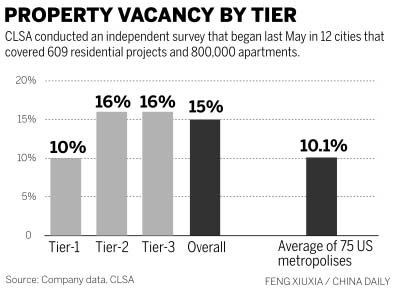
CLSA's estimate is based on an independent survey it began last May in 12 cities that covered 609 residential projects and 800,000 apartments. The survey team carried out home visits and went to projects to see how many lights were on at night.
It only surveyed units completed from 2007 to 2011 because the survey team felt adding houses completed in 2012 and thereafter might inflate the vacancy rates, because many buyers moved into their new homes one or two years after buying them.
 |
"The result is actually lower than what we had thought, because our experience told us the ratio could be roughly 25 percent," said Nicole Wong, regional head of property research of CLSA. She said vacancy rates in first-tier cities aren't that high, and higher ratios in some second-tier cities aren't a problem either.
In cities such as Zhengzhou and Tianjin, the vacancy rates were 23 and 21 percent respectively, but that could be reduced through massive population inflows.
But the situation in third-tier cities was far more worrisome, the team found. The construction spree of recent years left large inventories, but the population flows to fill those units just aren't there.
For those cities, 2014 will be a turning point, according to CLSA.
Last year, 790 million sq m of housing was sold in third-tier cities. By 2020, that area will shrink as much as 60 percent. But in first- and second-tier cities, sales areas will rise 6 to 12 percent. Overall, sales by 2020 will shrink by 36 percent.
This year "will be a turning point because as of last year, China's housing sales were equivalent to 11.9 percent of GDP. That's excessive, and unsustainable, given that at Hong Kong's property peak, just before its property crash in 1998, the ratio was just above 9 percent," said Wong.

Copyright 1995 - . All rights reserved. The content (including but not limited to text, photo, multimedia information, etc) published in this site belongs to China Daily Information Co (CDIC). Without written authorization from CDIC, such content shall not be republished or used in any form. Note: Browsers with 1024*768 or higher resolution are suggested for this site.
License for publishing multimedia online 0108263 Registration Number: 20100000002731