BEIJING -- Despite a further slowdown in the first quarter, China will not face a crash as some pessimistic observers warned of, a prominent Chinese economist has said.
Yu Yongding, an economist at the Chinese Academy of Social Sciences, disputed the pessimism based on historical
 |
|
 |
Yu was former member of the Monetary Policy Committee of the People's Bank of China and President of the China Society of World Economics. His opinion firstly appeared on Project Syndicate, one of the world's leading op-ed websites.
He said the complexity and distinctiveness of China's economy meant gloomy predictions were pointless, and that they have repeatedly emerged in the past 30 years but never came true. Yu also dismissed concerns over the country's high leverage ratio and property bubble.
China's high leverage ratio, which some believe will trigger a crisis or hard landing, should be interpreted with other detailed factors taken into account, rather than only based on the fate of developing countries that experienced a large-scale credit boom, he said.
One of the factors that can not be ignored is China's much higher saving rate. "The higher the saving rate, the less likely it is that a high debt to GDP ratio will trigger a financial crisis," Yu said, let alone successful cases of high-ratio countries like Singapore and the Republic of Korea.
In fact, the high ratio is mostly a result of the simultaneously high saving and investment rates, and the non-performing loan ratio of the country's major banks remained lower than 1 percent, Yu added.
He also dismissed China's real-estate price bubble as a catalyst for a crisis, as the country has no sub-prime mortgages and the down payment to buy a home exceeds 50 percent.
"Given that property prices are unlikely to fall by such a large margin, the bubble's collapse would not bring down China's banks," he said, stressing commercial banks could well survive in case prices fell by more than 50 percent
By the end of 2013, outstanding loans of the country's real estate sector totaled 1.46 trillion yuan ($237 billion), which made up 20 percent of China's yuan denominated lending, much lower than ratios of developed nations and indicating risks were controllable.
Housing demand remained strong boosted by the country's urbanization progress, as data from the statistics authorities showed 56 of 70 major Chinese cities saw month-on-month gains in new home prices in March.
In case the bubble bursts, plummeting prices would attract new home buyers in major cities, causing the market to stabilize, Yu predicted.
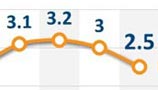
China's economy expanded at 7.4 percent year on year in the Jan.-March period.
Economists expect the central government to push forward reforms including tax breaks and opening monopolized sectors to private capital to vitalize the market and keep the growth rate at the proper range of around 7.5 percent.
|
 |
 |
| Feb manufacturing PMI drops to 50.2 | HSBC China's manufacturing PMI at eight-month low |

Copyright 1995 - . All rights reserved. The content (including but not limited to text, photo, multimedia information, etc) published in this site belongs to China Daily Information Co (CDIC). Without written authorization from CDIC, such content shall not be republished or used in any form. Note: Browsers with 1024*768 or higher resolution are suggested for this site.
License for publishing multimedia online 0108263 Registration Number: 20100000002731