|
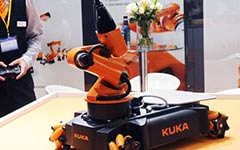
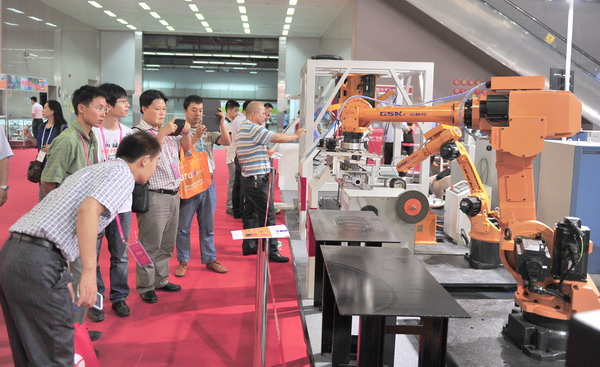 Domestically produced robots are shown at an international expo in Guangzhou, capital city of Guangdong province. China aims to have a relatively well-developed industrial robot industry by 2020,with three to five internationally competitive companies and eight to 10 supporting industrial clusters. LU HANXIN/XINHUA |
Guangzhou-based GSK CNC Equipment Co, one of the leading domestic computer numerical control providers, estimates its industrial robot sales will double to over 800 sets this year and 3,000 sets next year.
The company expects that domestic demand for the robots will surge by as much as 20 percent annually in the coming years, said Jiang Miren, deputy director of the general manager's office.
|
 |
|
 |
|
 |
The domestic market has been under-performing in the past few years, with industrial robots used in only a few sectors, such as automobile and high-end electronic industries, he said.
But manufacturers are increasingly shifting to robots as they seek to improve efficiency and a new generation of laborers demand higher incomes and better working environments.
As the population ages, "the problem of the demographic dividend has yet to fully present itself," Jiang said.
Zhang Lingyan, with research firm CCID Consulting, forecast in a report in February that "the use of industrial robots in China will grow by 16 percent year-on-year to 32,000 sets this year, with a broader spectrum of industries following the trend."
The industrial robot sector will embrace opportunities in the coming three years from government support, the need for industrial transformation and the weakening demographic dividend, Zhang said.
The government aims to have a relatively well-developed industrial robot industry by 2020, with three to five internationally competitive companies and eight to 10 supporting industrial clusters, according to a guideline on promoting the sector issued by the Ministry of Industry and Information Technology last December.
Earlier this month, the government of Guangzhou, capital of Guangdong province, joined a number of cities in approving an ambitious plan for developing the industry. It aims to have annual output of over 100 billion yuan ($16.13 billion) from the intelligent equipment industry and annual capacity of 100,000 sets of industrial robots and intelligent equipment by 2020.
More than 80 percent of manufacturers in Guangzhou will be using industrial robots and intelligent equipment by 2020, with the demand for robots increasing by more than 30 percent annually in the manufacturing-heavy Pearl River Delta area in Guangdong, according to the Guangzhou Commission of Economy and Trade.
Currently, more than 90 percent of robots and their core parts must be imported.

Copyright 1995 - . All rights reserved. The content (including but not limited to text, photo, multimedia information, etc) published in this site belongs to China Daily Information Co (CDIC). Without written authorization from CDIC, such content shall not be republished or used in any form. Note: Browsers with 1024*768 or higher resolution are suggested for this site.
License for publishing multimedia online 0108263 Registration Number: 20100000002731