Hainan province's delayed announcement that it discovered the illegal planting of genetically modified corn and cotton has triggered public concerns about how information relating to GM food in China is disclosed.
A statement released by the Hainan provincial agriculture department on Monday said that nine corn and cotton samples out of 107 specimens were identified as genetically engineered and that they were destroyed immediately in late December. Another six suspected samples were being examined at the time. The samples were taken from various trial farms operated by agricultural companies and institutes.
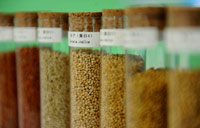 |
| Illegal GM crops destroyed in Hainan |
Many critics have asked what took the Hainan agency so long to publicize its detection of the illegal GM plants.
The department said that the destroyed samples and the samples under investigation came from illegal trial farms. It stressed that any trials on GM crops that have not secured government permission are banned, and those who conduct such trials will be punished in accordance with the law.
The department declined further comment.
Huang Dafang, a former member of the country's biosafety committee in charge of agricultural GM organisms - plants or animals created through genetic engineering - said China has strict regulations on GM food registration and production.
He said it's rare for scientists to ignore the government's certification procedure and that the public shouldn't panic. He added that agricultural authorities are on the lookout for illegal plantings of GM food every year.
But Shi Baozhong, a lawyer from Anhui province, disagreed.
Shi issued an open letter in September to the China Food and Drug Administration and the Ministry of Agriculture asking them to publicize information on GM food in China.
"It is not about a single case but the transparency of GM food," Shi said.
He said the local agricultural bureau should have released its statement on the destruction of the GM crop samples in December.
"If it is released timely, the public won't have so many doubts and concerns," Shi said.
During the annual legislative session in Beijing in March, Cui Yongyuan, a former TV talk-show host, said GM corn and rice are being grown illegally on a large scale in grain-producing provinces such as Hunan, Hubei, Jiangxi and Jilin.
Cui wrote on his micro blog on Saturday that the Ministry of Agriculture shouldn't pretend to be ignorant of the problem.
The ministry's press office did not answer calls on Tuesday, but on March 6, Agriculture Minister Han Changfu said the ministry will not tolerate any illegal plantings of GM crops.
Bio-safety certificates have been issued in China for some GM strains of cotton, rice, corn and papaya, he said, and only cotton and papaya can be planted for commercial purposes.
Import certificates for GM crops in China have been granted for soybeans, corn, rapeseed, cotton and beets, allowing them to be imported as raw materials for domestic processing, the ministry said.
Domestic debate over the safety of GM food has grown since the ministry issued bio-safety certificates to two strains of pest-resistant GM rice and corn in 2009.
The strains approved in 2009 still require production trials, which will take three to five years, before commercial planting can begin, according to the ministry. China planted almost 4 million hectares of GM pest-resistant cotton in 2013, according to a report in February from the Chinese Academy of Agricultural Sciences.
Contact the writers at wangqian@chinadaily.com.cn and liuxiaoli@chinadaily.com.cn

Copyright 1995 - . All rights reserved. The content (including but not limited to text, photo, multimedia information, etc) published in this site belongs to China Daily Information Co (CDIC). Without written authorization from CDIC, such content shall not be republished or used in any form. Note: Browsers with 1024*768 or higher resolution are suggested for this site.
License for publishing multimedia online 0108263 Registration Number: 20100000002731