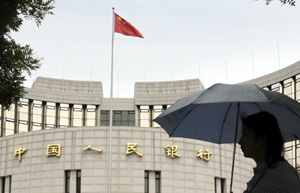
To dismiss worries over risks of large-scale money outflow, Lu noted that China has a massive four-trillion-dollar foreign exchange reserve and a 20-percent reserve requirement ratio (RRR).
If there is a money crunch in the interbank market, the central bank has a lot of room to inject liquidity, including cutting the RRR, according to Lu.
Rise or fall?
"It is widely perceived that the yuan-dollar rate is very close to its equilibrium level," said Lu, adding that neither trend appreciation nor trend depreciation will appear in the near term.
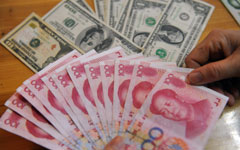 |
"In this perspective, the yuan is to some extent overvalued, rather than undervalued," Wang said.
J.P. Morgan's Zhu said although the band widening gives the yuan more room to fall, the currency is not shifting toward a depreciation trend due to China's stable current account surplus, the efforts in yuan internationalization and political pressure from major trading partners.
"We forecast that the yuan-dollar rate will remain stable in the near term, or experience small appreciations," Zhu said.
Whether the yuan rises or falls, analysts believe further band widening is highly possible as China has put financial reform on its priority agenda.
In addition to discussions about how a more flexible yuan will influence the Chinese economy, Lu advised China to reconsider ways to set the daily central parity rate.
As an intermediate step toward a market-based regime, China could peg the yuan to a basket of currencies weighed by the importance of its trading partners, he said.
Reform toward a real managed float requires a group of more confident and pragmatic political leaders who are truly believers in markets, Lu said.
"The current Chinese leaders are market-oriented," he said.
|
 |
 |

Copyright 1995 - . All rights reserved. The content (including but not limited to text, photo, multimedia information, etc) published in this site belongs to China Daily Information Co (CDIC). Without written authorization from CDIC, such content shall not be republished or used in any form. Note: Browsers with 1024*768 or higher resolution are suggested for this site.
License for publishing multimedia online 0108263 Registration Number: 20100000002731