 |
|
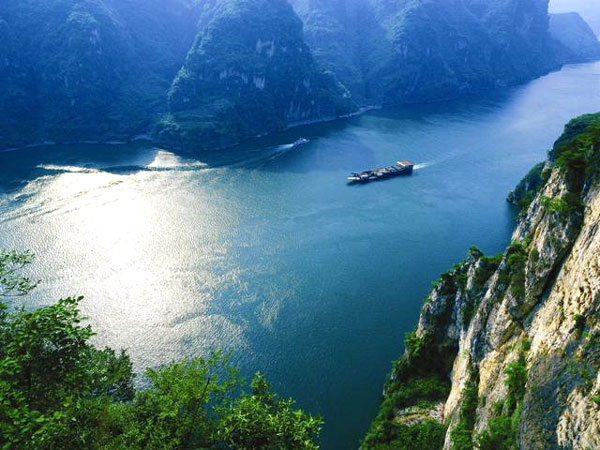
Yangtze River is the longest river in Asia and third longest river in the world only after Nile in Africa and Amazon in South America.[Photo/China Daily] |
Premier Li Keqiang last week revealed plans to balance regional growth by encouraging businesses to relocate from crowded coastal areas to less developed inland parts, along major roads and rivers.
In his report to the annual session of the National People's Congress (NPC), Li explained how China will exploit the Golden Yangtze River Waterway by developing an economic belt along its banks.
Different economic polices will be applied in different localities to encourage industrial transfer to help nurture new regional economic growth poles. The economic belt will connect all major cities in the upper, middle and lower reaches of the Yangtze, said Gu Shengzu, an economist, NPC deputy and former vice governor of Hubei province, in the middle reaches of Yangtze.
"More than three decades after opening up coastal regions, the announcement is a significant step towards an economic belt stretching all the way from the eastern coast the inland mountains in the west," said Gu.
The Yangtze River economic belt will cover seven provinces and two municipalities: Shanghai, Jiangsu, Anhui, Jiangxi, Hubei, Hunan, Chongqing, Sichuan and Yunnan. The regions account for some 40 percent of gross domestic product.
Transforming the growth model and promoting economic transfer are great incentives for manufacturing plants along the coast to relocate inland. Rising production costs, especially labor costs, mean many companies have chosen to move their plants to Southeast Asian countries. If the government does nothing to stem this process, central and western regions may remain undeveloped and balanced regional growth hard to achieve, said Gu.
Clusters of major cities along the Yangtze, including the Yangtze delta, already contribute substantially to the economy. Chengdu, capital of southwestern Sichuan province, best known for pandas and a leisurely lifestyle, has become a major manufacturing center, with about 70 percent of global iPads and half of Intel's high-end chips flowing out of the city.
Compared to their counterparts in coastal regions however, smaller cities in the west are far less developed.
"The Yangtze River economic belt will bring us more opportunities to expand regional cooperation," said Chen Zhongwei, head of Chengdu's logistics office.
Ma Li, a member of the national committee of the Chinese People's Political Consultative Conference, welcomed the initiative.
"Dividing work among all regions along the Yangtze will sharpen competitiveness, reduce production costs and yield economic benefits," said Ma, chief engineer of Dongfeng Motor Group, one of the major companies who expect to benefit through the plan.

Copyright 1995 - . All rights reserved. The content (including but not limited to text, photo, multimedia information, etc) published in this site belongs to China Daily Information Co (CDIC). Without written authorization from CDIC, such content shall not be republished or used in any form. Note: Browsers with 1024*768 or higher resolution are suggested for this site.
License for publishing multimedia online 0108263 Registration Number: 20100000002731