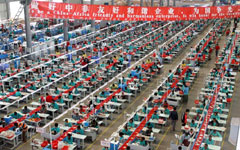
"Staff lived in an old apartment block not far from the factory and there was nowhere where you could spend your free time."
Jia says that after he had lived in Lagos for three years, he had made many close connections. It had become a second hometown for him.
Wang says: "After talks with Nigerian companies we also increased our level of local content from 3 percent to 20 percent."
|
 |
 |
One of the other Chinese shoemakers in Africa is Huajian Group of Dongguan, Guangdong province, which has operations in the Oromia region of Ethiopia.
Like many other Chinese shoe companies including Hazan that have been extremely fleet of foot in looking for expansion opportunities, Huajian went to Africa in 2012 mainly because of the cheaper labor.
In 2012, trade between China and Africa was worth more than $20 billion, 20 times what it was in 2000, but manufacturing in Africa still needs to be improved. Chinese companies can help with that endeavor, Wang says.
Africa offers the companies huge potential to expand their markets over the coming decade, he says.
The tough financial environment in the United States and Europe and rising labor costs in China have made the need to harness that potential all the more pressing, he says.
"For shoe companies, going out of the country with their own brands is the only way to survive the US and European slump."
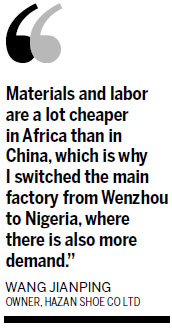
As such companies look for the right path to follow, they could do a lot worse than using as a role model Hazan, which has spent 20 years transforming itself from a local manufacturer to a global company.
"I've noticed that more shoe trading companies and factories that have focused on manufacturing products for other brands have collapsed under financial pressure, which bodes ill for the whole industry," Wang says
Of course, small and medium-sized companies that create brands and take them overseas run risks, but success will deliver them greater opportunities for higher profits, he says.
Having become a localized brand, Hazan has encouraged other businesses from China to work with it in Africa.
In November 2010 or 2009, almost seven or eight years after a Nigerian government initiative almost killed Hazan's dreams, the company signed an agreement with it that holds the promise of even more prosperous times.
The Zhejiang-Hazan Africa Free Trade Zone signals another transformation of Hazan, this time from a shoemaker to a business operating in many different industries.
The first and second phases of the project, occupying 116 hectares, are now being built. They will be open to businesses from Zhejiang wanting to carry out tax-free trading with Nigerian businesses.
|
 |
 |

Copyright 1995 - . All rights reserved. The content (including but not limited to text, photo, multimedia information, etc) published in this site belongs to China Daily Information Co (CDIC). Without written authorization from CDIC, such content shall not be republished or used in any form. Note: Browsers with 1024*768 or higher resolution are suggested for this site.
License for publishing multimedia online 0108263 Registration Number: 20100000002731