The regulation hits Chinese companies particularly hard because Chinese customers prefer the original texture of wood to processed wood board, Lu says.
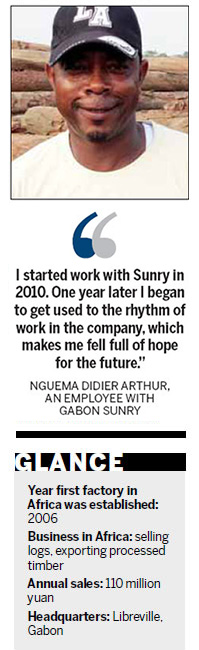
"In Chinese culture, wood is considered beautiful only when it is natural and unprocessed, especially when it is turned into classic Chinese furniture. Once it is cut into uniform-looking boards, its value drops significantly."
As a result, Gabon Sunry's exports dived in 2010, from 400,000 cubic meters a year valued at about 1 billion yuan to 100 million yuan.
There was another problem, too. Because most companies did not process logs, they did not have factories or equipment to process the trees they fell. So piles and piles of huge logs mounted up and were left to rot.
Sunry saw a silver lining, having set up two small processing factories as early as 2007, three years before the new regulation took effect. Nevertheless, with that capacity it was only able to mitigate its losses.
Over the following three years, Sunry expanded its factories, which were designed to make plywood and veneer. The annual value of its exports is expected to climb to 200 million yuan this year.
That has involved Lu changing the company's strategy since 2012 by transforming Sunry from a 100 percent log exporter, to a plywood and veneer processor, as well as a log provider to local processing companies.
"So stock is limited and cash flow is healthier," Lu says, adding that the company's sales of logs to local processors can earn the company at least 50 million yuan a year.
But Lu says doing that is just a temporary expedient, "because if we don't cut down trees and keep things going, we still need to pay millions in forest tax every year". On top of that, the cost of depreciation on equipment is at least 20 million yuan every year.
In the long run Lu still bets on processing.
"That is really a waste of our resources. By having our own processing, we can gain revenue from three areas: selling logs, processing and trading. "
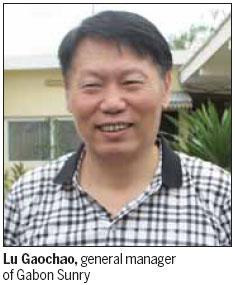
And there is at least one obvious drawback with the current factories: they were bought from French businesses so the product lines were designed more for Europeans than for Chinese. Since 2012 the company has brought in extra equipment to make timber for the Chinese market.
Seventy percent of its products, in total about 14,000 cubic meters, are exported to Europe, and the rest goes to China. The biggest customers are French railways and companies in the Netherlands and Italy.
Sunry says it exports about 20,000 cubic meters of sawn timber to Europe and the United States a year.
It owns five major areas of forest. Lu says the company plans to build a processing plant for each. "The original plan was to build factories in the city, preferably in Libreville port, making exports easy. But I'm now thinking of putting them near the forests."
The reason is that only about half of the timber produced ends up in the final product, which means half of the trees felled will end up as scrap.
The forests Sunry owns are between 300 km and 700 km from the city, which means half the transport costs would be wasted if processing was not done on site. "By moving factories close to forests, we cut this cost," Lu says.
Don't miss
|
 |
 |

Copyright 1995 - . All rights reserved. The content (including but not limited to text, photo, multimedia information, etc) published in this site belongs to China Daily Information Co (CDIC). Without written authorization from CDIC, such content shall not be republished or used in any form. Note: Browsers with 1024*768 or higher resolution are suggested for this site.
License for publishing multimedia online 0108263 Registration Number: 20100000002731