With online shopping cutting into the market share of brick-and-mortar stores, more and more traditional businesses are eager to get Web-savvy.
However, setting up online marketplaces and selling products directly online are not the only option. More traditional businesses, especially those in the service sectors, are expected to team up with Internet companies and ride the wave of the online-to-offline (O2O) business model in China, which will not only help them to survive but also to blossom in the Internet era, analysts say.
Mao Ajing, an e-commerce analyst with the Beijing-based research firm Analysys International, said the attitude of traditional stores toward e-commerce has gradually changed with the latter's development in China.
"In the early stages, traditional stores looked down on e-retailers. Then, they saw them as enemies. But now, more and more traditional stores are embracing the Internet, which has completely changed the shopping habits of Chinese people," Mao said.
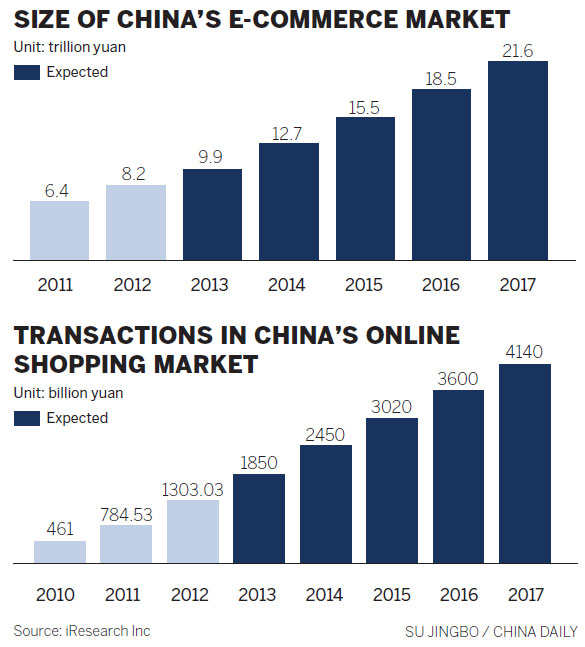
China's e-commerce market grew at an average rate of 71 percent from 2009 to 2012, said a report from global management consulting firm Bain & Co. But chain retailers have had a tougher time over the past several years.
Online retailing in China totals 6 percent of all purchases but in big, developed cities in China, more and more people prefer to shop online.
Online sales in the first 10 months have overtaken sales at brick-and-mortar stores for the first time in Beijing, becoming the main engine that is driving up the city's purchases.
Companies that have suffered the most from the e-commerce bonanza have made moves to transform themselves in the era of the Internet. Suning Commerce Group Co Ltd, China's largest electrical appliances retailer by sales, is one of those that has made aggressive moves.
The company changed its name from Suning Appliance Co Ltd in early 2013, aiming to adapt to its future business scope and business model. What's more, in an effort to transform into an e-commerce company, Suning unified the prices of its online and offline stores and launched an open platform to allow third-party vendors to sell on its online marketplace.
However, Mao from Analysys International said not every company is cut out to make drastic moves as Suning did to transform into an e-commerce company.
"Some of the traditional businesses will only use an online platform as a marketing channel. Some will digitize part of their management systems, such as memberships and orders to become more efficient," said Mao.
On the Nov 11 shopping festival in 2013, Alibaba Group Holding Ltd for the first time invited about 30,000 offline stores to participate in the nation's largest online shopping spree.
Alibaba has since expanded its O2O service by including more traditional businesses into its plan. The company in December launched a mobile meal-order app called Tao Diandian, which allows users to pre-order restaurant dishes before heading out to eat.
With the growing popularity of mobile Internet use, the line between online and offline shopping will be blurred, which may eventually put an end to the competition between online and offline businesses, said Mao.
Copyright 1995 - . All rights reserved. The content (including but not limited to text, photo, multimedia information, etc) published in this site belongs to China Daily Information Co (CDIC). Without written authorization from CDIC, such content shall not be republished or used in any form. Note: Browsers with 1024*768 or higher resolution are suggested for this site.
License for publishing multimedia online 0108263 Registration Number: 20100000002731