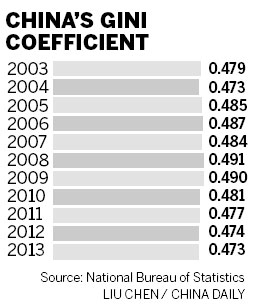
China's Gini coefficient index declined for the fifth consecutive year in 2013 to reach 0.473, according to figures disclosed by the National Bureau of Statistics on Monday.
The result is based on 400,000 households surveyed throughout the country.
The Gini coefficient index, as defined by the World Bank, measures the extent to which the distribution of income or expenditure among individuals or households within an economy deviates from a perfectly equal distribution. A Gini index of 0 represents perfect equality and an index of 1 represents perfect inequality.
The figure prompted different views. Some considered it lower than expected. Yang Weixiao, a senior analyst specializing in macroeconomics and fixed income from Lianxun Securities Beijing, said the figure based on a national average is very likely to be "under-reported".
"First of all, it is widely perceived by the general public that the income gap is widening. In addition, any calculation on property income or off-payroll income is not included in this research. The calculation of farmers' incomes is not researched proportionately. Therefore, it is hard to say whether it truly reflects the big picture," said Yang.
Chen Yanli, a mid-level administrator at a multinational company in Shanghai, makes roughly 12,000 yuan ($1,960) every month. She is quite content with her current income, saying she has "no ambition to compare her income with that of the so-called rich second generation". But she has also sensed a huge income disparity, especially between those who perform simple manual work and the super rich who spend lavishly on luxury cars.
"It is really the workers living on the bottom rung of the social hierarchy who are likely to call for an immediate income distribution revolution. They earn so little and work for such a long time. They are simply too tired to spend," she said.
Regarding this, Ma Jiantang, chief of the statistics bureau, reiterated the importance of deepening the income distribution revolution as well as increasing the wage of low and medium-income people. He also said it is crucial to regulate legal income and crack down on illegal sources of cash to ensure a more rational income distribution.
However, Ma said a reading above 0.4 still indicates much room for improvement regarding income distribution according to World Bank standards.
Yiping Huang, chief economist of emerging Asia at Barclays Capital, said it was "not in a position to judge the accuracy of the estimated Gini coefficients". But it has noticed a steady improvement since 2008, suggesting a largely under-appreciated trend of structural improvement.
"The trend of the coefficients provided by the statistics bureau looks reasonable to us (although we will have to wait and see if declining inequality has become a new trend). In fact, we believe these data constitute evidence of a largely under-appreciated trend of structural improvement in recent years. Such improvements include, among others, improvements in income distribution, increases in the share of household income within the national income and the share of consumption of the gross domestic product, a narrowing of the current account surpluses and the declining energy intensity of the economy," said Huang.
Economists at Barclays Capital have also noticed a rapid wage growth in recent years, which, they explained, was probably also behind the recent improvements in income distribution highlighted by the statistics bureau, because low-income households rely more on wage income and high-income households rely on investment returns or corporate profits.
"If the past trend was households subsidizing corporations, then the new trend is redistribution of income from corporations to households as rising labor costs increase wage incomes but squeeze corporate profits," said Huang.
Copyright 1995 - . All rights reserved. The content (including but not limited to text, photo, multimedia information, etc) published in this site belongs to China Daily Information Co (CDIC). Without written authorization from CDIC, such content shall not be republished or used in any form. Note: Browsers with 1024*768 or higher resolution are suggested for this site.
License for publishing multimedia online 0108263 Registration Number: 20100000002731 

