|
 |
|
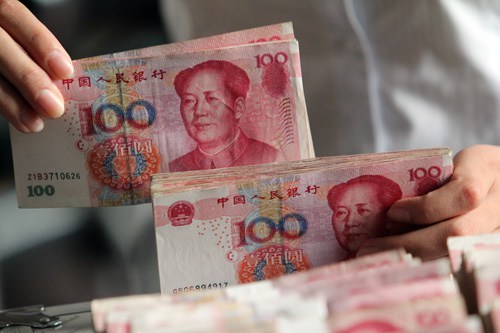
MONEY MATTERS: A clerk from a rural credit cooperative in Linyi, Shandong Province, counts banknotes. [Photo/bjreview.com.cn] |
China's banking system suffered another credit crunch at the end of 2013. On December 19, trading in the high-value payment system was extended by an extra half an hour, followed by rumors of breaches of contract among banks. Although relevant departments clarified the rumors, interbank lending rates, which measure the cost at which Chinese banks lend to one another, shot up, with overnight, seven-day and 21-day lending rates all soaring to over 10 percent, and the 14-day rate even rocketing to 12 percent. This has raised fears of a credit crunch.
To alleviate stress and fears in the monetary market, the People's Bank of China (PBC), the country's central bank, launched a short-term liquidity operation (SLO) on December 18, 2013. The next day, the central bank announced through its official Weibo, the Chinese equivalent of Twitter, that it had carried out an SLO and pledged to inject liquidity to qualified financial institutions via the SLO. On December 20, the central bank said on its Weibo account that it has injected over 300 billion yuan ($49.56 billion) to the financial markets within three days. On December 24, the central bank injected another 29 billion yuan ($4.79 billion) by selling seven-day reverse repurchase (repo) contracts, a process in which central banks purchase securities from banks with an agreement to resell them in the future.
With strong intervention from the central bank, this round of the credit crunch was immediately eased, with the interbank money rate falling back to below 7 percent on December 26.
This was the second outburst of a credit crunch in China's banking system in 2013. The overnight interbank lending rate hit a record high of 25 percent on June 20 when the first one hit. Fears filtered through the monetary market to the whole financial sector, causing stock markets to rout and surging yields on money management products and bonds.
The liquidity shortage in June was worse than the more recent crunch, but the central bank turned its back on the distress in June while injecting liquidity immediately after the recent credit crunch, signaling more attention had been paid to liquidity shortage by the central bank.
Yi Xianrong, a researcher with the Institute of Finance and Banking of the Chinese Academy of Social Sciences (CASS), said the credit crunch may become a common phenomenon in China in the future. Frequent occurrence of cash crunches, however, has exposed severe problems in China's financial markets that can only be solved by major institutional reforms.
Reasons
Many find it hard to understand why credit crunches would frequently occur in China's banking system, which seems to hold abundant cash. Central bank data showed that year-on-year growth of M2, a broad measure of money supply that covers cash in circulation and all deposits, surpassed the target of 13 percent during the first 11 months of 2013. During the same period, credit growth and total social financing both exceeded the whole-year volume for 2012.
A report issued by Founder Securities on December 23 said internal reasons are the major factors contributing to the December credit crunch. On the one hand, fiscal deposits are far below the expectations, and on the other, the central bank has tightened the monetary market by cancelling its usual "open market operations." In addition, rampant expansion of interbank businesses have worsened the liquidity shortage, said the report.
Copyright 1995 - . All rights reserved. The content (including but not limited to text, photo, multimedia information, etc) published in this site belongs to China Daily Information Co (CDIC). Without written authorization from CDIC, such content shall not be republished or used in any form. Note: Browsers with 1024*768 or higher resolution are suggested for this site.
License for publishing multimedia online 0108263 Registration Number: 20100000002731 

