

|
 |
|
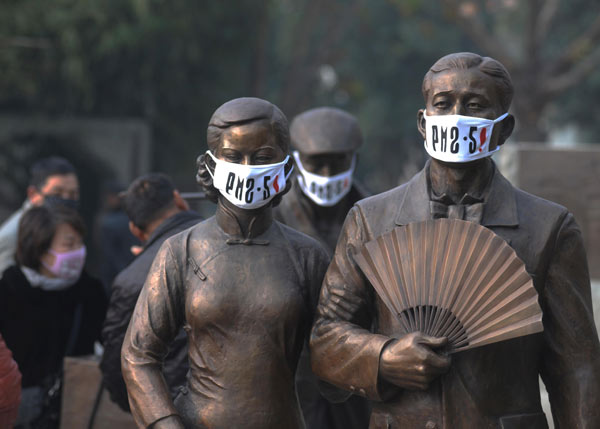
Street statues in Wuhan, Hubei province, on Dec 25 reflect ongoing public concern with PM2.5 pollution. Liu Dajia / For China Daily |
Despite pledges in the last year to fight pollution, Beijing saw barely any improvement in air quality in 2013.
The intensity of major air pollutants remained much the same in 2013 as they were in the previous year, figures released by the Beijing Environmental Protection Bureau on Thursday indicate.
PM2.5, airborne particulate matter smaller than 2.5 micrometers in diameter, was 2.5 times the national standard, it said.
Authorities began to monitor and publish PM2.5 levels in 2013.
"It's a long process to fight the capital's pollution," Fang Li, spokesman for the bureau, said at a news conference on Thursday.
The PM2.5 reading in 2013 was on average 89.5 micrograms per cubic meter. By comparison, the national standard stands at 35 micrograms per cubic meter.
PM2.5 was found to be the major pollutant — accounting for 77.8 percent — on most smoggy days.
Southern Beijing saw much higher PM2.5 readings in 2013 compared with the north.
As for other major air pollutants, the figures showed a slight reduction in the average intensity of sulfur dioxide and PM10 compared with 2012, but nitrogen dioxide increased by 7 percent year-on-year.
The most heavily polluted days were in January 2013, seriously affecting the year's average reading, said Yu Jianhua, a Beijing Environmental Protection Bureau official.
Zhang Dawei, head of the Beijing Environmental Monitoring Center, said that compared with 1998, the intensity of sulfur dioxide declined by 78 percent, nitrogen dioxide by 24 percent and PM10 by 43 percent.
But considering the rising number of automobiles and the increasing energy consumption in all walks of life, Beijing's goal to reduce PM2.5 concentration to 60 micrograms per cubic meter by the end of 2017 — down 25 percent from 2012 — will "remain very challenging", he said.
"The stricter standards require the capital to come up with more stringent measures," he said.
A report released by the Chinese Academy of Sciences on Monday said secondary inorganic aerosols — fine, solid particles comprising sulfate and nitrate that result from a photochemical reaction — are responsible for 26 percent of Beijing's PM2.5, whereas vehicle emissions account for about 4 percent.
However, the bureau contradicted that report on Thursday, saying that automobile emissions are still the major source of PM2.5 in Beijing.
Figures from the bureau reveal that automobile emissions account for 22.2 percent of PM2.5 concentration, after pollution from neighboring provinces (24.5 percent). It is followed by coal consumption (16.7 percent), industrial pollution (16.3 percent) and dust (15.8 percent).
Related readings:
 Smog shrouds many parts of China |
|
|
|
|
|
|
|
|

Copyright 1995 - . All rights reserved. The content (including but not limited to text, photo, multimedia information, etc) published in this site belongs to China Daily Information Co (CDIC). Without written authorization from CDIC, such content shall not be republished or used in any form. Note: Browsers with 1024*768 or higher resolution are suggested for this site.
License for publishing multimedia online 0108263 Registration Number: 20100000002731 










 Op Rana
 Berlin Fang
 Zhu Yuan
 Huang Xiangyang
 Chen Weihua
 Liu Shinan