Comments
  Print
Print  Mail
Mail  Large Medium Small
Banker says blocking Sany, Huawei Technologies 'totally groundless'
A decision in the United States to block Sany Group Ltd's involvement in a wind farm project was "foolish" and blurred the whole picture of a general open US attitude toward Chinese investment, a top Chinese banker said at the Summer Davos.
Li Ruogu, chairman of the Export-Import Bank of China, a State policy bank, said the US move was "totally foolish" and its justification of the move citing "national security" was totally "groundless".
 |
|
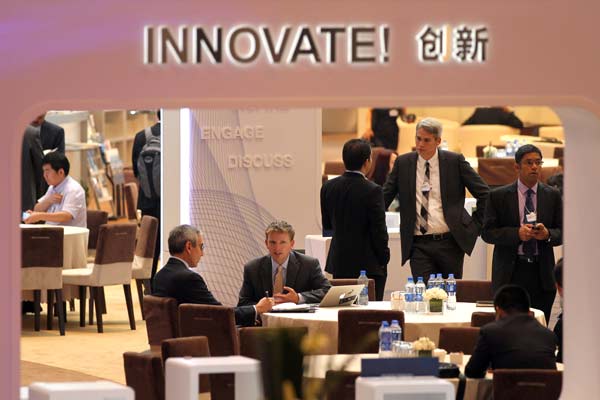
Participants chat during a break at the Summer Davos in Dalian, Liaoning province, on Thursday. Francisco J. Sanchez, US undersecretary of commerce for international trade, said the US is open to Chinese investment. China's direct investment in the US grew 123.5 percent to $4 billion in 2012.[ZOU HONG / CHINA DAILY] |
Sany is a major Chinese private-sector maker of heavy equipment.
"The case, as well as the Huawei case, is so typical. I don't know why the US government made such a foolish decision. Isolated cases have made an issue that should not be a ‘problem' into a ‘problem'," he said.
Ralls Corp, which is incorporated in Delaware and operates out of Peachtree City, Georgia, is privately owned by two Chinese nationals — Duan Dawei, chief financial officer of Sany Group, and Wu Jialiang, a Sany vice-president and general manager of subsidiary Sany Electric Co.
Ralls had sought to build or acquire US wind farms where Sany's turbines could be used. One of those farms was in Oregon, near restricted airspace above a US military base. US President Barack Obama decided to block the project.
Another private company Huawei Technologies Ltd, was barred from access to the US market, also over national security concerns.
The two cases, both of which took place in late 2012, generated widespread media coverage and heated debate in China, exacerbating the perception that the US market is persistently closed to Chinese investment.
But Francisco J. Sanchez, US undersecretary of commerce for international trade, a panelist in the Davos discussion in Dalian, dismissed the claim that the US is not open to Chinese investment.
He said that 98 percent of foreign countries' outbound direct investment into the US requires no government review, and the vast majority of investments that are reviewed are ultimately approved.
"This (review) is not unique to China. It applies to (companies) all over the world who hope to invest in or acquire technologies that we deem as related to national security," said Sanchez.
"I want to make it very clear that the United States welcomes Chinese investment," he said.
The two cases did obscure the overall robust picture of Chinese investment in the US. In 2012, the Chinese mainland's ODI in the US grew 123.5 percent to hit $4 billion. At that point, the US became the second-largest ODI destination after Hong Kong, according to a Chinese government report.
By the end of 2012, cumulative investment from the Chinese mainland in the US was $17 billion.
Ma Weihua, chairman of Wing Lung Bank and former chairman of China Merchants Bank, said most Chinese companies are not prepared to "go global", as shown in the high percentage of failures in ODI.
In 2010, more than 10 percent of Chinese outbound investments failed, one of the highest rates in the world. More than 20 percent had lost money, he said.
"Many Chinese companies do not have a clear strategy in terms of going abroad. Some just go abroad because they think they are big enough. And the low-price strategy they generally apply abroad could easily provoke local repulsion," Ma said.
Li, the banker, pointed out that Chinese executives abroad have very limited integration with local cultures: They tend to work and live in an isolated environment in foreign markets and seldom communicate with locals. They are particularly weak at language skills.
"Throughout my intensive travel experience in Africa, my personal feeling is that Chinese culture hardly resonates with these developing nations," he added.
Michael Andrew, global chairman of KPMG International, a global auditing corporation, said the firm's survey of Chinese clients showed that a few years ago, 86 percent of Chinese companies that had outbound investment were State-owned enterprises. Their investment was overwhelmingly concentrated in energy and infrastructure. But now more investors are targeting areas such as food, technology and services.
 4th World Internet Conference concludes
 Starbucks Reserve Roastery set to open in Shanghai
 Smile to get discounts in Tmall's unmanned supermart
 Top 10 richest Chinese women in 2017
 World leading internet sci-tech achievements released in Wuzhen
 Top tech CEOs take to the stage as Wuzhen Summit opens
 Major topics at 4th World Internet Conference
 'Made in China' dinosaurs amuse the world

Copyright 1995 - . All rights reserved. The content (including but not limited to text, photo, multimedia information, etc) published in this site belongs to China Daily Information Co (CDIC). Without written authorization from CDIC, such content shall not be republished or used in any form. Note: Browsers with 1024*768 or higher resolution are suggested for this site.
License for publishing multimedia online 0108263 Registration Number: 20100000002731