Comments
  Print
Print  Mail
Mail  Large Medium Small
|
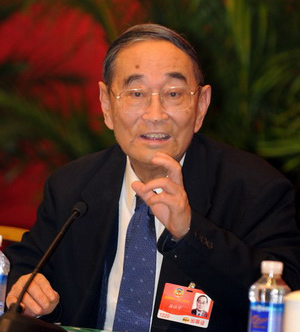 Li Yining |
Reporter: China's urbanization rate reached 52.57 percent in 2012, official figures show. What are your suggestions for improving the quality of Chinese urbanization?
Li Yining: Statistical results may vary a lot in different surveys. The development of urbanization means both rural and urban residents enjoy equal rights. Its fundamental goal is to improve people's happiness, not merely a high urbanization rate. Urban-rural social security integration and public services should also be improved along with the process of urbanization. As the gap between urban and rural areas narrows, rural residents can choose where to live in the future; town or city.
Actually, among the 52.57 percent of the 72 million city dwellers, 15.8 million migrant workers didn't enjoy the same fruits of urbanization as urban residents. People register under two categories in the hukou system: urban or rural. The migrant workers are registered as rural in their hukou. Although they have become permanent residents in a city, they are still rural in hukou. They are not endowed with equal access to urban infrastructures and public services.
In my view, China's urbanization rate is below 50 percent, it shows the urban and rural areas are now well integrated. The urbanization still means a lot to the country.
Reporter: What do you think the urbanization target is for China?
Li: Western countries have 80 percent to 90 percent of its populations or more flock to cities. If China were to catch up, the country would see 900 million to one billion people dwelling in cities, out of the 1.3 billon population. This will lead to low level living conditions. Even though larger city populations create more service sector employment, many farmers still won't get a job. The western country's urbanization model doesn't suit China's condition.
In western developed nations, urbanization developed along with industrialization, not under systematic urban planning. By then officials hadn't developed a sense of sustainable development or optimum city-size. As a result, problems such as low level urban living conditions turned irreversible. Most industrialized countries suffered "urban diseases", including environmental degradation, over-crowdedness, higher unemployment rate and poor public order. Some countries even saw a reverse urbanization trend, where the poor continue to swarm into cities, while the rich move to suburbs and villages.
Reporter: What urbanization route do you think China should take?
Li: China must take measures that suit its own condition. These measures consist of three parts. First, the renovation of the old cities. Plants should be relocated to outer areas so old cities can be transferred into business and service areas. Second, new industrial districts should be built so as to stimulate the economy and promote urbanization through industrialization. Third, the construction of new rural communities. They are also called new socialist countrysides, referring to rural communities near towns. These communities not only attract farmers to live in, but also lead them towards urbanization; towards rural and urban integration.
Urbanization is not just about building apartments. It calls for forestation, good public service, and a development model of a circular economy. As new rural communities become better established, and with the hukou system abolished, urban-rural social welfare and security are to be better integrated, thus new rural communities will become new communities, without the distinction of being either urban or rural.
Reporter: What difficulties do rural residents face in getting an urban hukou?
Li: There are three aspects. The first one is unemployment. We need to provide famers with a job, and allow them to lease their contracted farmland or transfer their land-use rights. In this way, they may get enough money to start small businesses in the town. We can also guide the farmers of a village to engage in a certain business, for example, the logistics industry.
The second is the low level public service. Schools of each level, hospitals, clinics, and other infrastructures should be better equipped.
The third aspect is that farmers find it difficult to adapt to urban life. Living in apartments makes it hard to interact with neighbors. However, despite these inconveniences, famers still welcome relocation as their living conditions are improved.
The above three problems are fixable. A tougher problem is that famers think it's unfair that they don't get long-term subsidies once their houses are demolished.
 Snow sculptures and ice lanterns heat up Harbin
 Cyclists sit back as they pedal through Guangzhou
 Liquor enterprises enter busy season in N China
 Monkeys enjoy Christmas feast in Zhengzhou
 Beijing designer turns sneakers into smog masks
 Oddly-shaped daffodil bonsai catches eyes in Shenzhen
 Young visitors astonished by space experience in Zhengzhou
 Localized Jeep Compass to hit the market

Copyright 1995 - . All rights reserved. The content (including but not limited to text, photo, multimedia information, etc) published in this site belongs to China Daily Information Co (CDIC). Without written authorization from CDIC, such content shall not be republished or used in any form. Note: Browsers with 1024*768 or higher resolution are suggested for this site.
License for publishing multimedia online 0108263 Registration Number: 20100000002731